
Blog > SAP ECC Explained: Why Modern Businesses Are Moving Beyond This Legacy ERP System
SAP ECC Explained: Why Modern Businesses Are Moving Beyond This Legacy ERP System

If you’ve ever explored the enterprise software space, chances are you’ve heard of SAP ECC. For more than two decades, this system has been the backbone of enterprise resource planning (ERP) for thousands of organizations worldwide. It brought order to complex business operations, helped standardize workflows, and connected finance, logistics, and human resources into one system.
But times are changing. Companies that once relied on ECC now face new challenges that the system wasn’t designed to solve. The purpose of this article is to explain what SAP ECC is, highlight its strengths and limitations, and show why so many businesses are exploring newer SAP solutions or complementary tools like SAP ECC payment processing to modernize operations.
What is SAP ECC?
SAP ECC is an on-premises enterprise resource planning (ERP) system developed by SAP, one of the world’s largest enterprise software companies. It is used by tens of thousands of organizations across manufacturing, distribution, financial services, and the public sector.
ECC is built around a set of integrated modules, each covering a core business function:
- FI (Financial Accounting) – general ledger, accounts payable, accounts receivable
- CO (Controlling) – cost management and internal reporting
- MM (Materials Management) – procurement and inventory
- SD (Sales and Distribution) – order management and customer billing
- HR (Human Resources) – payroll, time tracking, and workforce management
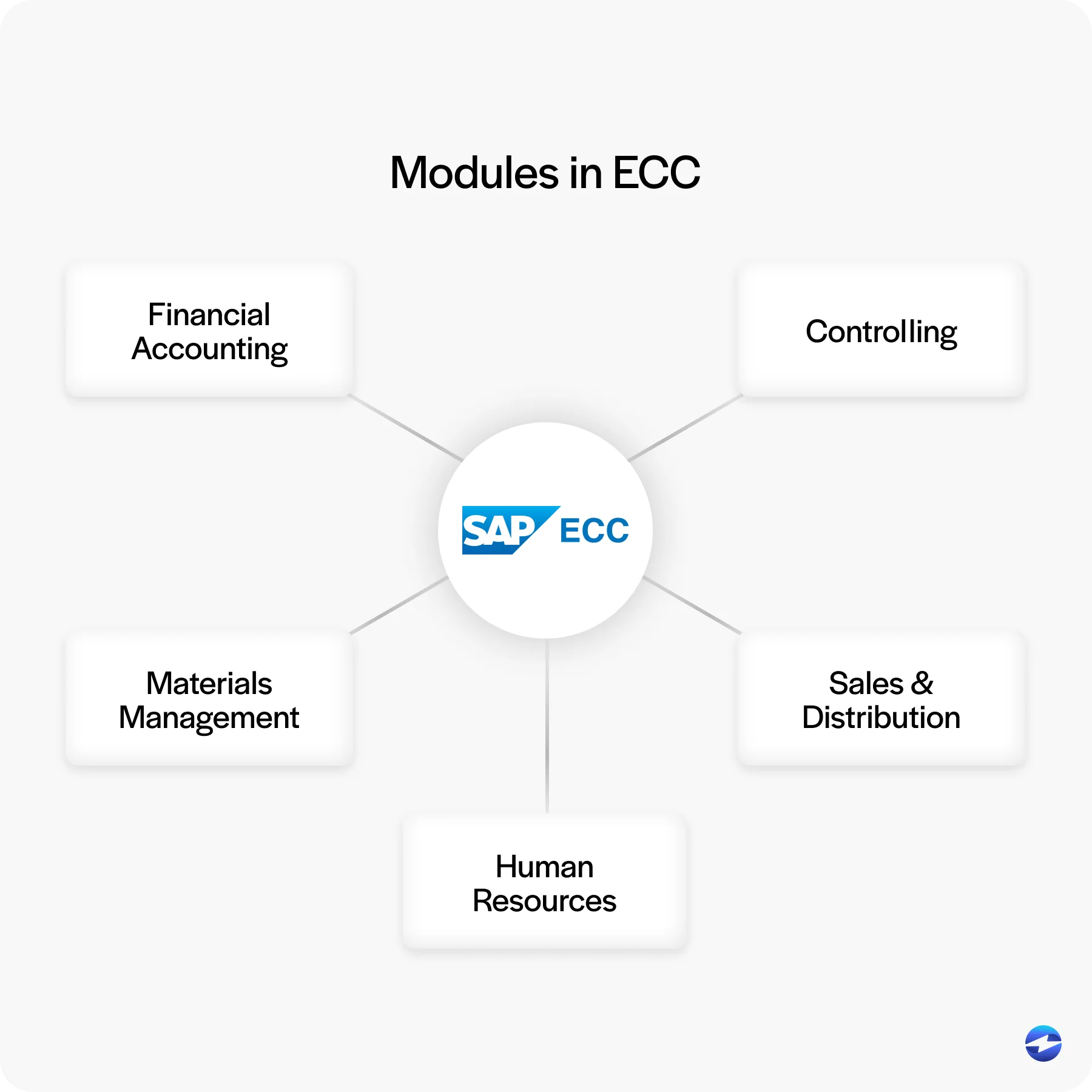
Rather than running separate tools for each function, organizations using ECC manage all of them inside one system with shared data. That level of integration was a significant shift for many businesses when ECC launched, and it remains the core reason so many organizations still rely on it today.
What Does SAP ECC Stand For?
SAP ECC stands for Enterprise Central Component, also referred to as SAP ERP 6.0. The name reflects its original purpose: a single central hub connecting every major business function, including finance, supply chain, sales, and HR, under one system.
When most people say “SAP ECC” today, they mean SAP ECC 6.0, released in 2005. It is the version SAP is actively sunsetting and the one at the center of most migration conversations right now.
SAP ECC 6.0: The Most Widely Used Version
SAP ECC 6.0 was released in 2005 as part of SAP Business Suite 7 and became the standard for large enterprise implementations worldwide. Over its lifespan, SAP released Enhancement Packages (EHP1 through EHP8) that added functionality without requiring a full system upgrade. Which package your organization is running now directly determines your SAP support timeline.
- ECC 6.0 EHP 0 through EHP 5: Mainstream maintenance ended December 31, 2025. No extended maintenance option is available from SAP.
- ECC 6.0 EHP 6, 7, and 8: Mainstream maintenance ends December 31, 2027. Extended maintenance is available through December 31, 2030 at an additional cost.
EHP 8 is the final version of the ECC platform. SAP has confirmed there will be no ECC 7.0, and has designated SAP S/4HANA as its long-term replacement.
Strengths of SAP ECC
There’s a reason SAP ECC has had such a long lifespan. First and foremost, it’s reliable. Many companies still trust it to run their most critical operations without disruption. Over the years, ECC has built a reputation for being steady and dependable—a system you could count on.
Another strength is its depth. ECC was built with industry-specific processes in mind. Whether you were a manufacturer, a distributor, or a service-based company, there were modules and configurations to fit your needs. Combined with the ability to customize, ECC gave businesses the flexibility to shape the system to their own operations.
Finally, there’s the community around it. Because ECC has been so widely used, there’s a massive ecosystem of consultants, developers, and support resources available. This network made it easier for businesses to find the help they needed to keep their SAP solutions running.
Limitations of SAP ECC
As strong as ECC has been, it comes with limitations that are hard to ignore. One major issue is that it was built primarily as an on-premises system. In today’s cloud-first world, that can feel restrictive. Maintaining servers, handling upgrades, and ensuring connectivity across geographies requires significant resources.
Cost is another limitation. Licensing, support, and customization all add up. For smaller or fast-growing companies, the price tag of maintaining ECC can be daunting. Then there’s the user experience. Compared to modern cloud-based ERPs, ECC’s interface feels dated and less intuitive.
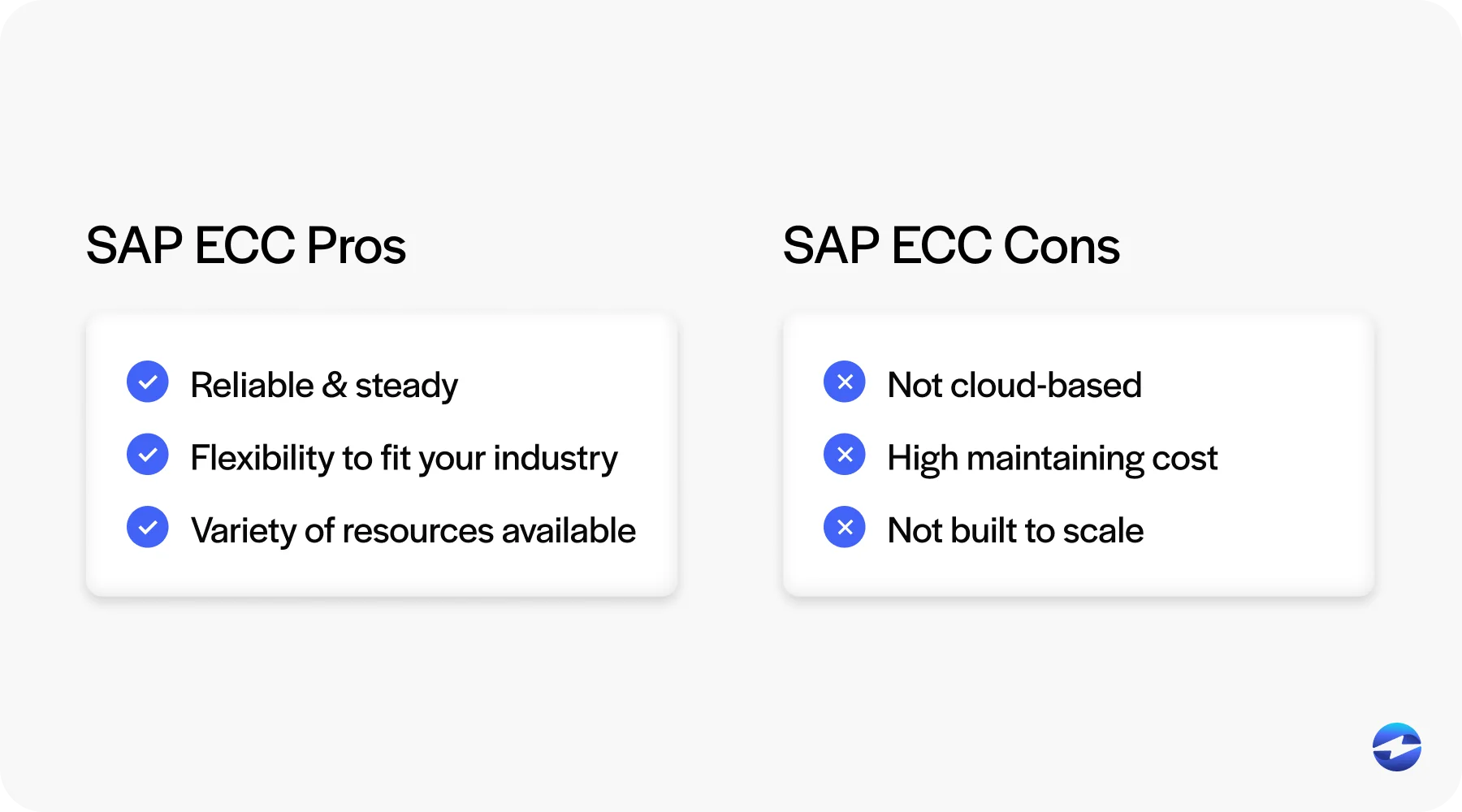
Lastly, scalability is a real concern. As companies expand quickly or shift toward more digital business models, ECC sometimes struggles to keep up. While customization can solve certain issues, it can also create long-term complexity that’s hard to manage.
SAP ECC vs SAP S/4HANA: Key Differences
SAP S/4HANA is the designated long-term replacement for ECC, but the two systems differ in ways that go beyond a simple version upgrade.
| SAP ECC | SAP S/4HANA | |
|---|---|---|
| Deployment | On-premises only | Cloud, on-premises, or hybrid |
| Database | Oracle, SQL Server, IBM DB2, or other | SAP HANA in-memory database only |
| User interface | SAP GUI (traditional desktop) | SAP Fiori (browser-based, mobile-friendly) |
| Analytics | Batch reporting | Real-time, built into the system |
| AI and machine learning | Requires third-party add-ons | Built into the core platform |
| SAP support | Mainstream ends 2027, extended ends 2030 | Supported through at least 2040 |
The migration is not a simple upgrade. Because S/4HANA runs exclusively on the HANA database, every migration requires a database switch regardless of deployment model. Organizations with heavily customized ECC environments often treat the move as a multi-year transformation project.
Why Businesses Are Moving Beyond SAP ECC
The reality is that many organizations are at a crossroads with ECC. Cloud adoption is no longer a nice-to-have; it’s quickly becoming the default way businesses expect to operate. Companies want ERP systems that are accessible from anywhere, require less maintenance, and can adapt as their needs evolve. Modern SAP software and competing platforms offer real-time analytics and far more intuitive user experiences—areas where ECC shows its age.
Cost pressures also shape decisions. Subscription-based cloud systems give companies predictable expenses and can lower the burden of maintaining on-premises infrastructure. At the same time, SAP has made it clear that its future lies with S/4HANA, signaling that ongoing investments in ECC may not pay off in the long run. Between rising expectations from users, financial considerations, and SAP’s own product roadmap, it’s no surprise that more businesses are exploring what comes after ECC.
SAP ECC End of Life and Support Deadlines
SAP’s maintenance deadlines for ECC are firm. Which one applies to you depends on your enhancement package.
ECC 6.0 EHP 0 through 5
Mainstream maintenance ended December 31, 2025. No extended maintenance option is available.
ECC 6.0 EHP 6, 7, and 8
Mainstream maintenance ends December 31, 2027. Extended maintenance is available through December 31, 2030 at additional cost, with reduced scope.
After 2030
SAP’s standard on-premises support for ECC ends entirely.
What this means in practice
ECC systems keep running after these dates, but the safety net erodes. No new security patches means vulnerabilities go unaddressed. No legal and regulatory updates means staying compliant with tax and financial reporting gets harder over time. With Gartner estimating roughly 17,000 SAP customers still on ECC in 2027, demand for migration consultants will only intensify as the deadline approaches.
Not ready to migrate yet?
EBizCharge connects directly to SAP ECC to automate payment posting, reduce manual AR work, and maintain PCI compliance without touching your ECC system. It is a practical way to modernize payments now while your migration strategy takes shape.
Optimizing Payments in SAP ECC with EBizCharge
While some companies are moving on, many still rely on ECC for their daily operations, especially for financial workflows like SAP billing. This is where the EBizCharge payment processing solution comes in as a valuable add-on. It integrates directly with SAP ECC to streamline payment operations, reduce manual effort, and modernize a legacy system.
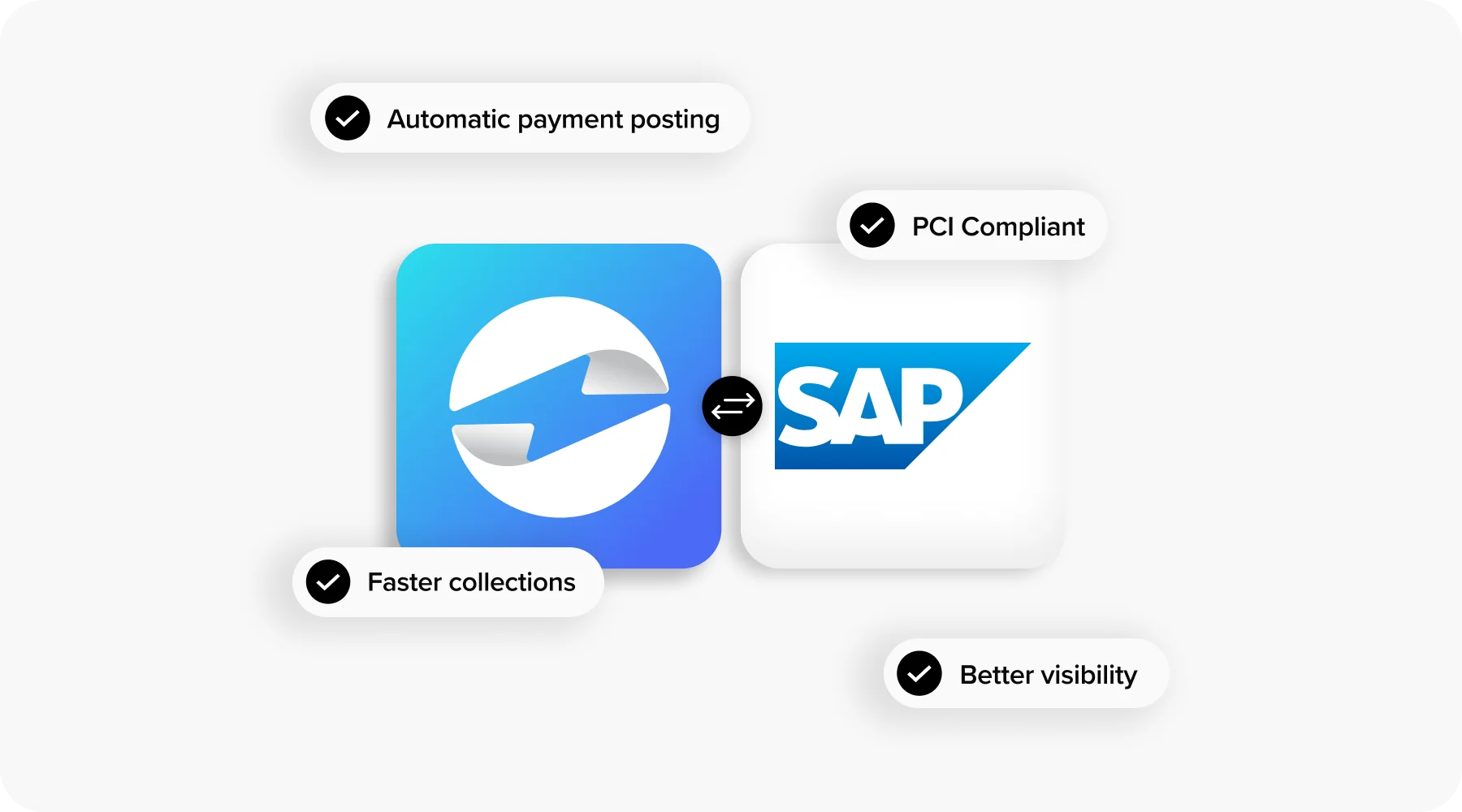
With EBizCharge, payments are automatically posted into accounts receivable and the general ledger. That means less manual entry, fewer errors, and faster reconciliation. Customers also gain access to online portals where they can pay invoices at their convenience—something that ECC by itself doesn’t offer.
From a compliance standpoint, EBizCharge adds another layer of protection. Built-in security features support PCI compliance requirements, protecting sensitive cardholder data. By pairing SAP billing software with a reliable payment processing solution like EBizCharge, businesses can cut costs, speed up collections, and improve the customer experience.
The best part is scalability. As transaction volumes grow, EBizCharge scales alongside your SAP system, making it a long-term option for companies that still rely on ECC but want more modern capabilities. For businesses running SAP Business One specifically, SAP Business One payment processing brings that same scalability directly into your ERP so payments post automatically without any manual reconciliation.
Best Practices for Moving Away from SAP ECC
Even if you’re using add-ons like EBizCharge to optimize SAP billing, the reality is that ECC won’t be around forever. Planning for the future is essential. The best approach is to create a clear roadmap that considers your business’s size, needs, and current setup.
Start by assessing all your current customizations and integrations. Many companies have years of tweaks built into their ECC systems, and not all of them will translate seamlessly into newer environments. Cleaning up your data early makes migration easier later.
Training employees is another critical step. Moving from ECC to a newer SAP solution or even another platform entirely requires change management. Teams need to understand why the change is happening and how it will benefit them. This is especially true for finance and IT teams who spend the most time inside the system.
The Future Beyond SAP ECC
SAP ECC represents a milestone in ERP history and a signpost pointing to the future. It proved how powerful integrated systems could be, but it also highlights the challenges of relying on legacy technology in a cloud-driven world. The real takeaway isn’t just that ECC is aging—it’s that businesses now have a chance to rethink how their systems support growth, agility, and customer experience.
For companies still running ECC, the decision isn’t only about when to move on but how to get the most value while planning that transition. Integrations, like those offered through third-party payment processors or enhanced SAP billing software, can bridge gaps and buy valuable time. At the same time, exploring modern SAP solutions or cloud-based ERPs sets the stage for long-term efficiency and competitiveness.
In other words, ECC’s story isn’t just about what it was—it’s about what comes next. The organizations that succeed will be the ones that prepare thoughtfully, align technology with strategy, and view change not as a disruption but as an opportunity to strengthen their financial and operational foundations.