

Blog > How Healthy Is Your Invoice-to-Cash Process? Data from 553 Finance Professionals
How Healthy Is Your Invoice-to-Cash Process? Data from 553 Finance Professionals

Most businesses think they have a handle on their receivables. The invoice goes out, the payment comes in, and the cycle repeats. Seems simple enough, but when you actually start asking people how long that cycle takes, and how much of it is still manual, the answers are a lot more candid than you may expect.
We surveyed 553 finance and accounting professionals about their invoice-to-cash process to build a real-world AR benchmark covering DSO, collections staffing, and payment bottlenecks. Here’s what the data shows.
Key Takeaways
Here are the top AR statistics from the survey before we break down each question.
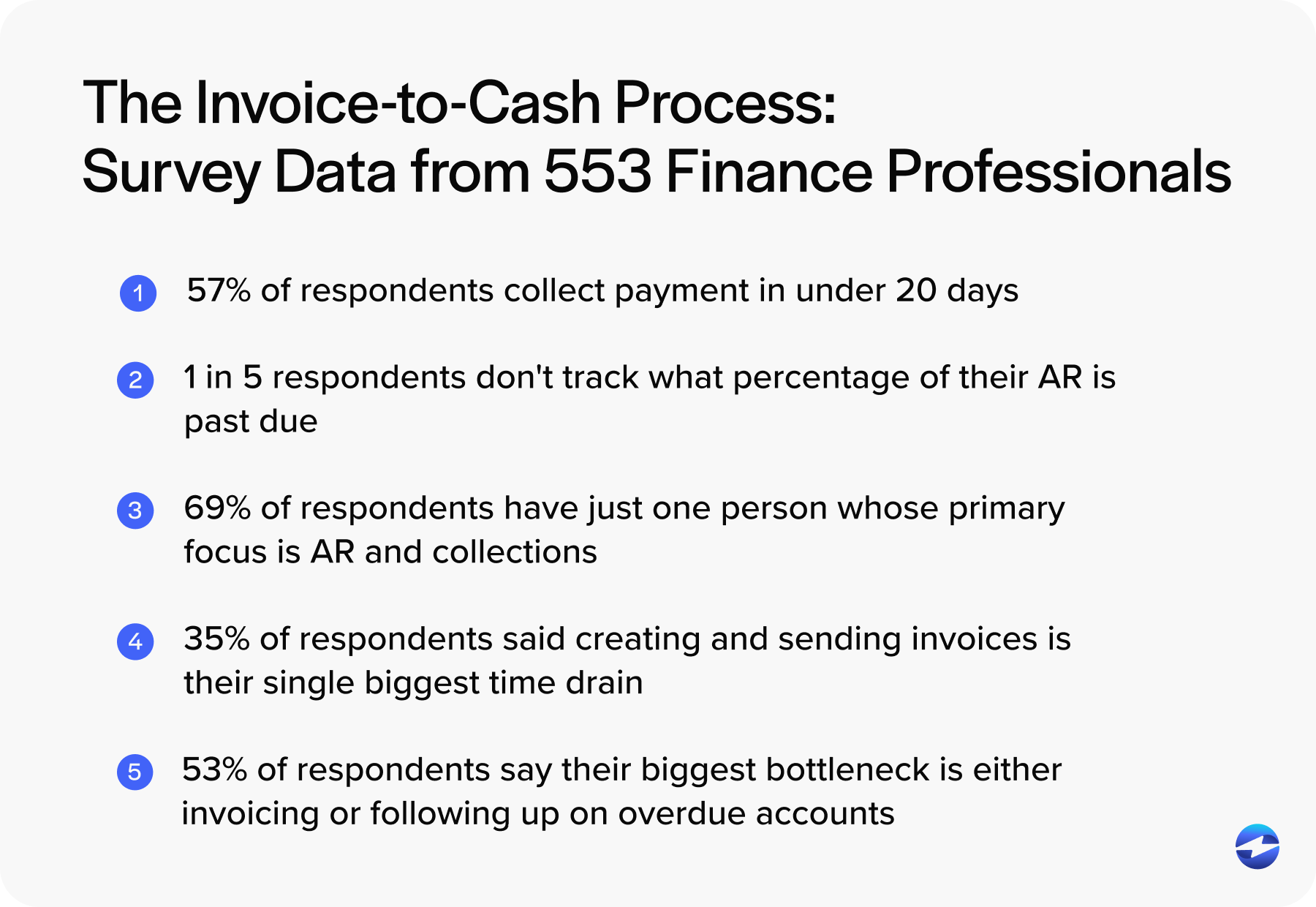
- 57% of respondents collect payment in under 20 days, but 25% are waiting more than 30 days. A gap that carries real cash flow consequences.
- 1 in 5 respondents don’t track what percentage of their AR is past due, meaning a significant share of finance teams have no visibility into aging receivables.
- 69% of businesses have only one person handling all AR and collections. Most companies don’t have a collections department and instead, are running a one-person show.
- 35% of respondents said creating and sending invoices is their single biggest time drain (more than follow-ups, reconciliation, or disputes combined).
- 53% of respondents said their biggest bottleneck is invoicing or following up on overdue accounts. This means two automated steps in AR are still eating the most time.
Methodology
EBizCharge surveyed 553 professionals in 2026. All respondents were active evaluators of payment processing solutions rather than a general population sample.
The survey consisted of four questions covering the most common AR performance metrics: Days Sales Outstanding (DSO), AR aging, collections staffing, and invoice-to-cash bottlenecks. Of the 553 respondents who started the survey, 511 answered all four questions. The remaining 42 only answered the first two questions, so these responses are included when applicable.
Respondents were primarily finance and accounting decision-makers actively evaluating payment software at the time of the survey.
Q1: How Long Are Businesses Actually Waiting to Get Paid?
Roughly 57% of respondents report a DSO under 20 days while 25% of respondents are waiting more than 30 days.
The majority of respondents (313 of the 553) have a DSO under 20 days. This a good benchmark that typically reflects short payment terms, consistent follow-up, and customers who pay without much friction.
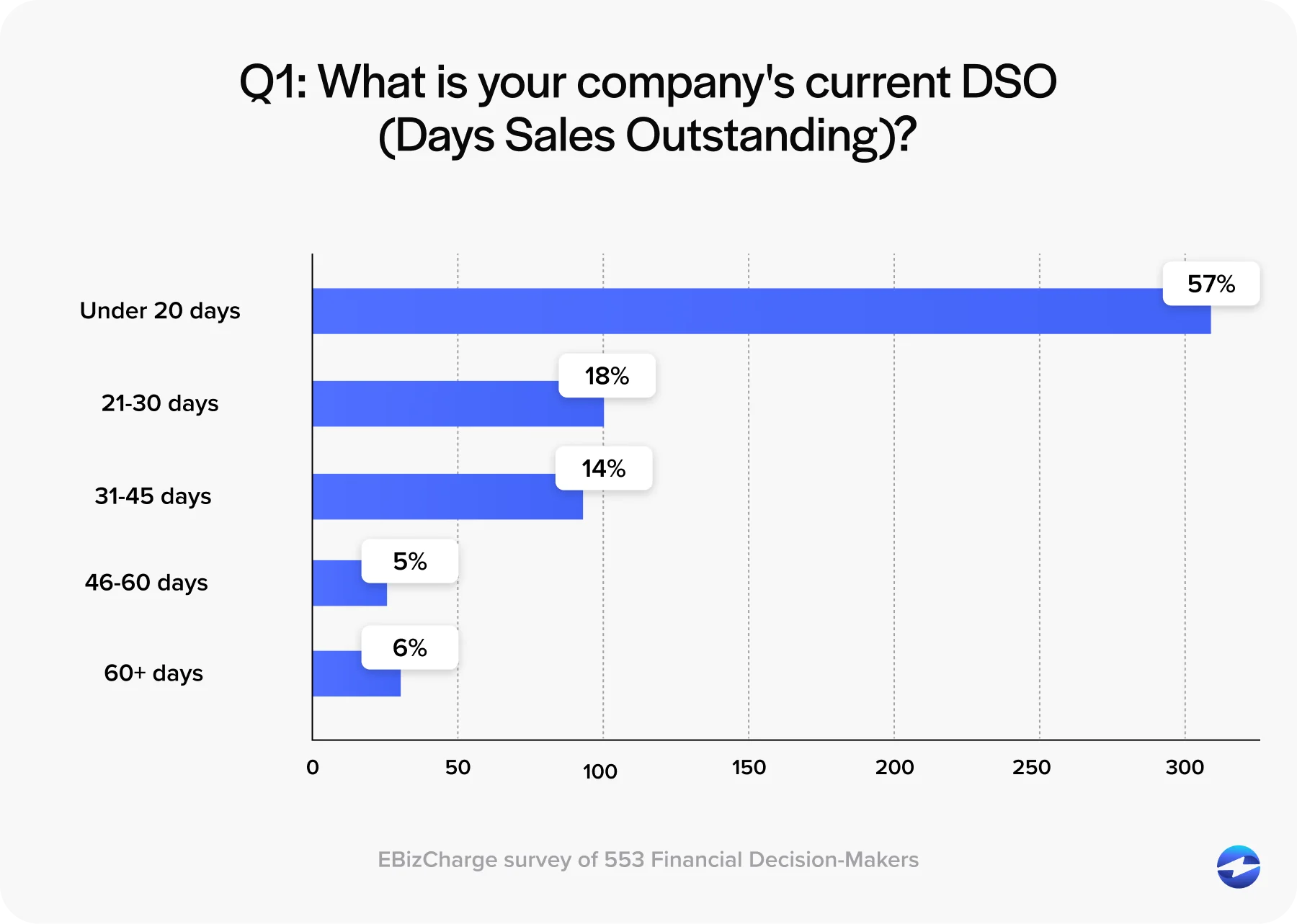
Here’s the full DSO breakdown:
- 57% have a DSO under 20 days
- 18% have a DSO of 21–30 days
- 14% have a DSO of 31-45 days
- 5% have a DSO of 46-60 days
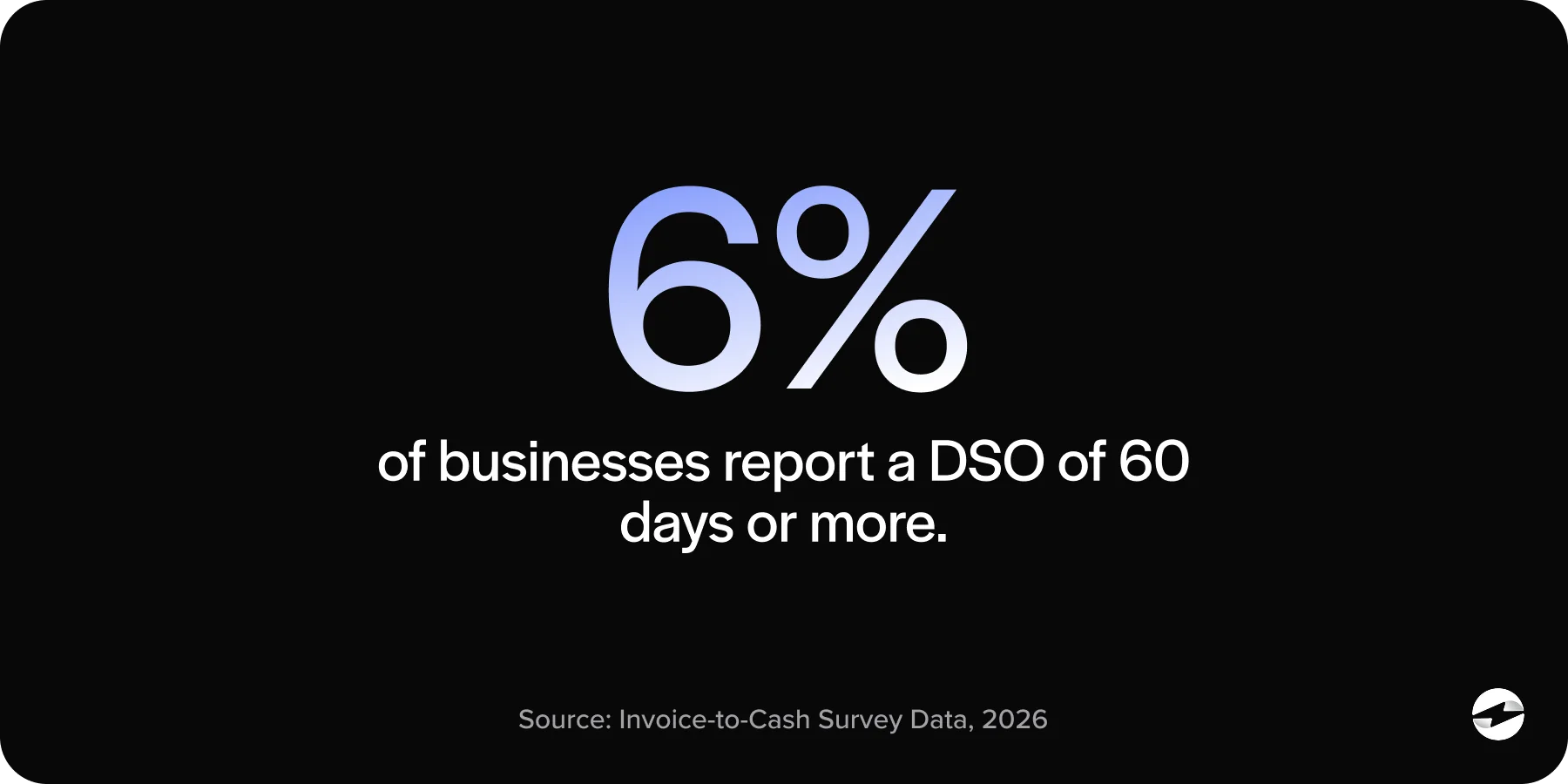
- 6% have a DSO of 60 days or more
When you add up the respondents collecting at 31 days or later, that comes out to 25% of the surveyed businesses waiting a month or more to get paid.
The 60+ day group is also worth noting. At that DSO range, the gap between revenue earned and cash available is wide enough to affect operating decisions: payroll timing, vendor payments, capital planning.
For example, a business generating $500,000 a month in AR with a 60-day DSO has roughly $1 million sitting in unpaid invoices at any given time. For businesses in this bracket, the goal isn’t marginal improvement. It’s a process overhaul.
Q2: How Much of Your AR Is Already Past Due?
One in five businesses aren’t aware of how much of their AR is already past due, and roughly 12% of respondents reported more than 20% of their collections late.
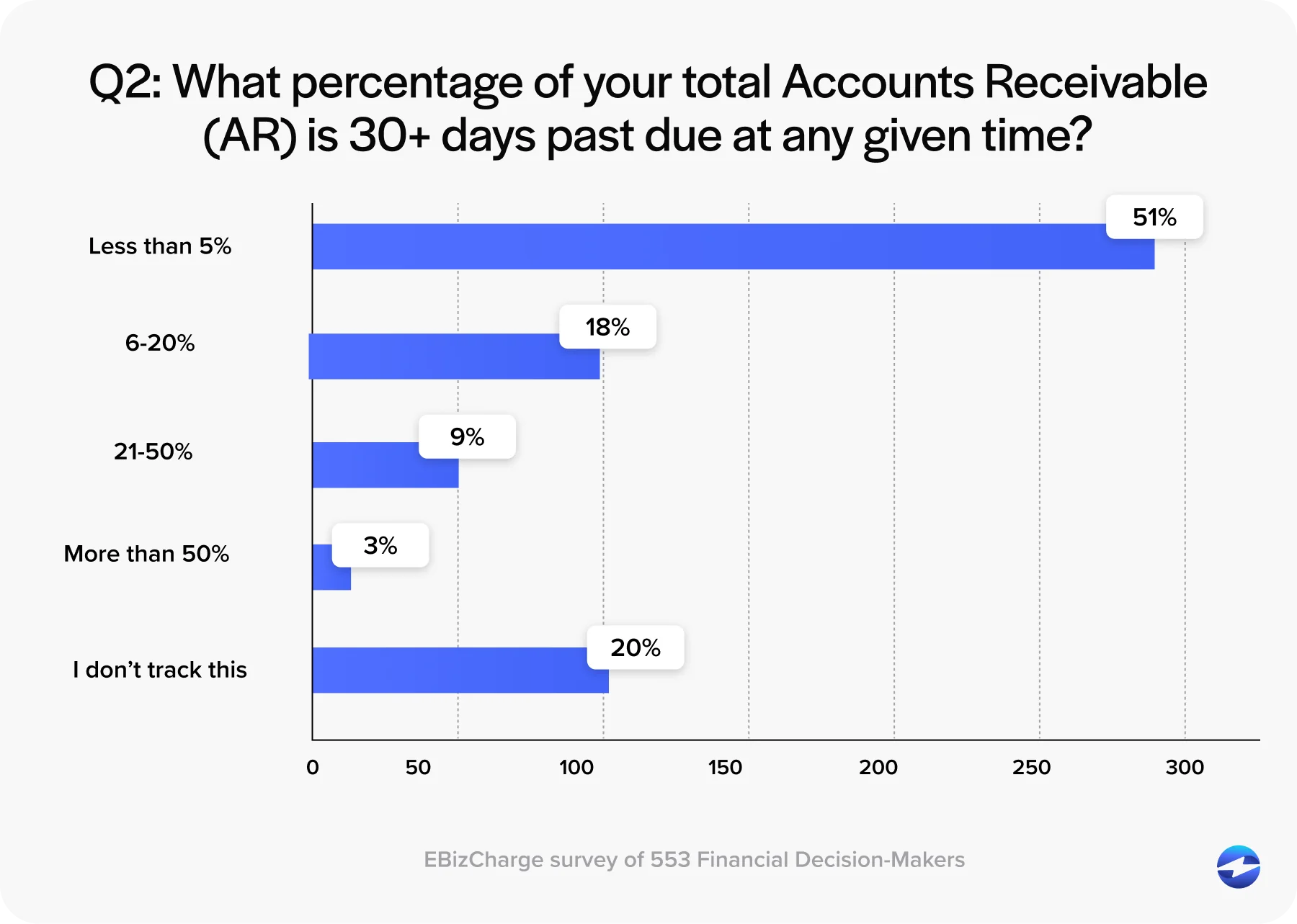
Respondents were asked what percentage of their total AR is 30+ days past due at any given time. Here’s the full breakdown:
- 51% said less than 5% of their AR is 30+ days past due
- 18% said 6-20% of their AR is 30+ days past due
- 9% said 21-50% of their AR is 30+ days past due
- 3% said more than 50% of their AR is 30+ days past due
- 20% said they don’t track this at all
Among respondents who track their overdue AR, most are in decent shape. Roughly 51% of respondents reported less than 5% of their total AR 30+ days past due. That’s healthy. Whereas 18% are dealing with 6-20% past due, which is also manageable but worth improving.
Then things took a turn.
Roughly 9% of respondents reported 21-50% of their AR past due. Another 3% of businesses surveyed reported more than half of all their outstanding receivables sitting beyond the 30-day mark. For those in this group, payment collections should be treated as a core business priority, not a back-office afterthought.
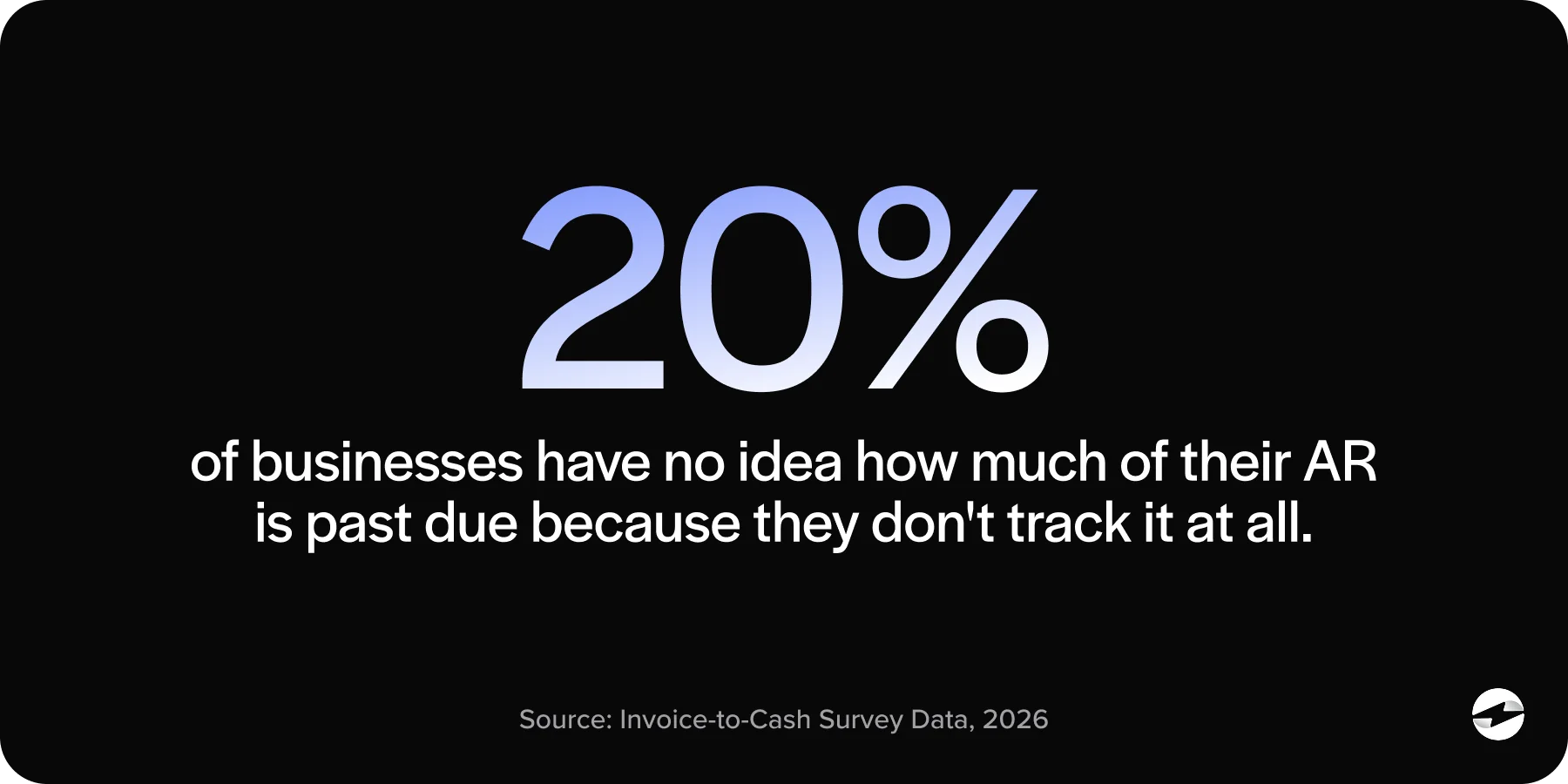
Another surprising takeaway is that 20% of respondents said they simply don’t track past due invoices. Ignorance is bliss they say (until you run out of operating cash flow).
One in five businesses in this survey had no visibility into how much of their AR was aged past 30 days, a sign that the real issue may not be billing, but visibility.
By the time an unpaid invoice becomes a write-off, it may be 90 days old, the customer has gone silent, and the window to collect has likely closed.
Q3: Who’s Actually Focused on AR at Most Businesses?
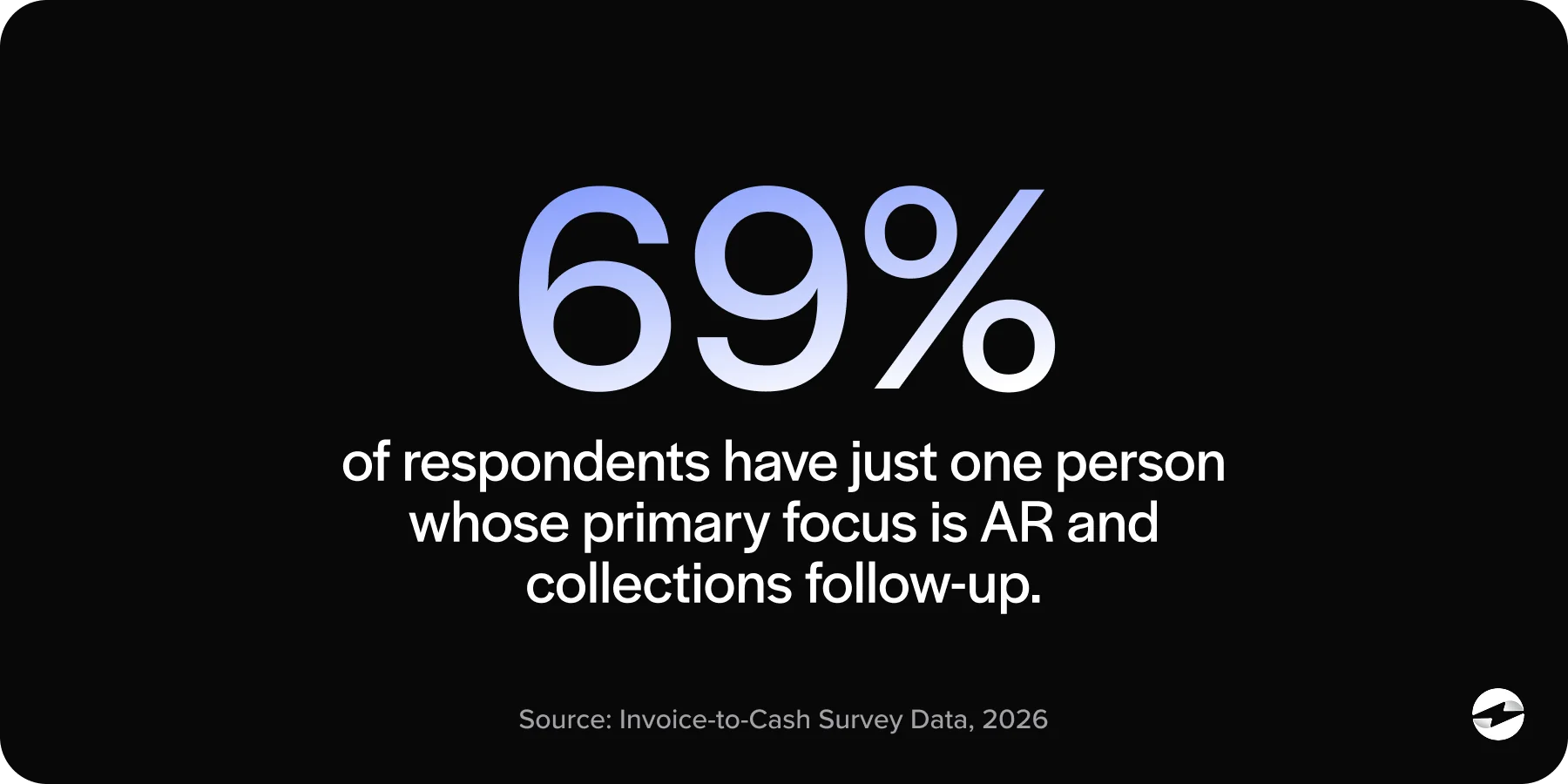
Approximately 69% of companies reported that just one person spends the majority of their time handling collections and AR follow-up.
Respondents were asked how many people on their team spent most of their time on collections and AR follow-up. It’s worth noting that this question measures dedicated focus, rather than total headcount. For example, a company with a ten-person finance team could still answer ‘one person’ if only one of them spends most of their time on AR.
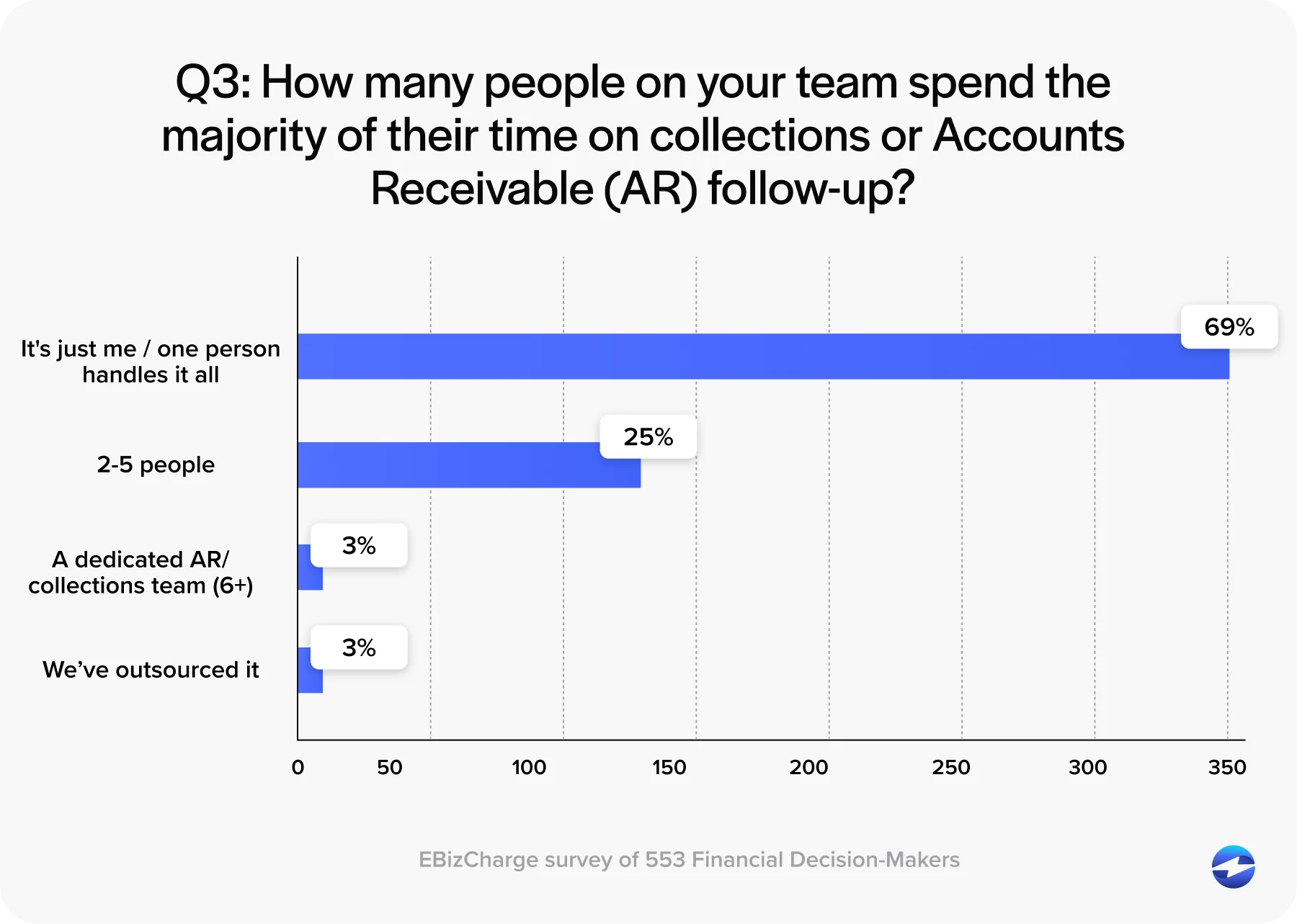
Here’s the full breakdown:
- 69% reported only one person focused primarily on AR and collections
- 25% reported 2-5 people focused primarily on AR and collections
- 3% reported a dedicated team of 6 or more focused primarily on AR and collections
- 3% reported that they outsource collections entirely
These results indicate that 352 of the 511 respondents said at most one person has AR as a primary responsibility. For small businesses, this may mean the owner, controller, or office manager is carrying the collections workload on top of other high-priority tasks.
With one person handling this follow-up, the concern isn’t only bandwidth. Since AR requires consistent, attentive follow-up, any disruption to a person’s routine can also disrupt cash flow.
For example, a company could quickly fall behind on collecting payments if this person takes time off, or worse, leaves the company without a clear handoff of which accounts are near or past due.
Q4: Where Does the Invoice-to-Cash Process Actually Break Down?
Roughly 35% of respondents said creating and sending invoices is their single biggest time drain. More than follow-ups, reconciliation, and disputes combined.
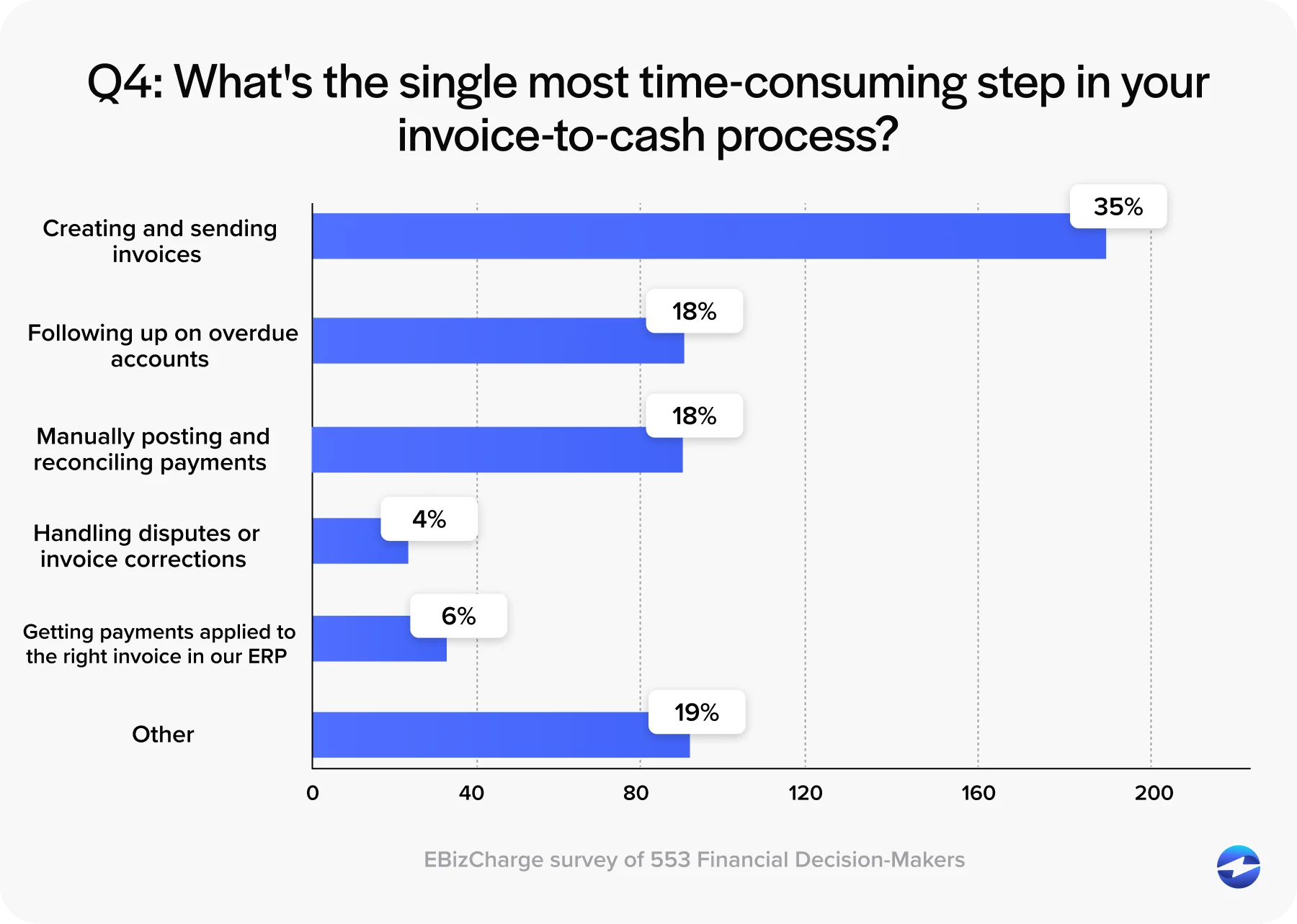
Respondents were asked to name the single most time-consuming step in their invoice-to-cash process. Here’s the full breakdown:
- 35% said creating and sending invoices
- 18% said following up on overdue accounts
- 18% said manually posting and reconciling payments
- 6% said getting payments applied to the right invoice in their enterprise resource planning (ERP) system
- 4% said handling disputes or invoice corrections
- 19% selected other
These results indicate that 177 of the 511 respondents reported invoicing as the biggest drain — the front end of the process, which should be relatively simple and repeatable, is where the most time is going.
Additionally, 18% flagged overdue account follow-ups as their biggest time drain, and another 18% pointed to manual payment posting and reconciliation. This also aligns with a separate survey, where 29% of respondents reported their teams spending 31+ hours per month on manual invoicing, payment entry, and collections.
Combine invoicing and late payment follow-up, and you’re looking at 53% of all responses. More than half of the surveyed respondents said their biggest bottleneck is either getting invoices out the door or chasing down late ones.
The top four time-consuming steps identified by respondents all share something in common: none of them have to be manual. Invoicing can be automated. Follow-ups can run on a schedule. Payments can post and reconcile without anyone touching them.
The businesses still doing this work by hand aren’t dealing with an unsolvable problem. They’re dealing with a process that hasn’t been updated yet.
What the Data Reveals for Businesses
The responses to all four questions in this survey likely point to one common theme: most businesses are managing AR reactively rather than proactively.
Most respondents aren’t following up on invoices until they’re already overdue, aren’t tracking or reviewing aging reports, and aren’t catching payment application errors until customers report the discrepancy themselves. Their process is largely manual, dependent on one person, and already behind by the time anyone notices.
The survey results point to a quarter of respondents waiting more than 30 days to collect, one in five businesses having no visibility of which invoices are past due, and 69% of businesses relying on only one person to primarily handle AR operations and follow-up. Even more surprising, the single biggest time drain in the entire invoice-to-cash process isn’t collections or disputes. It’s invoicing, the very first step.
The gap between businesses collecting payments in under 20 days and those waiting 60 or more comes down to AR best practices. Businesses that collect fast tend to have systems in place that keep the process moving without someone manually pushing it forward at every step. The ones struggling are largely doing the same work, just slower and with less information. That’s the AR gap EBizCharge’s AR collection features were built to close.
EBizCharge: An Invoice-to-Cash Solution Built to Reduce DSO and Automate AR
EBizCharge is an all-in-one payment processing software that helps businesses get paid faster, reduce DSO, and automate the manual work that slows down the invoice-to-cash process. From sending invoices to collecting payment and reconciling it in your accounting system, EBizCharge is an integrated invoice-to-cash application/platform that handles the entire cycle in one place.
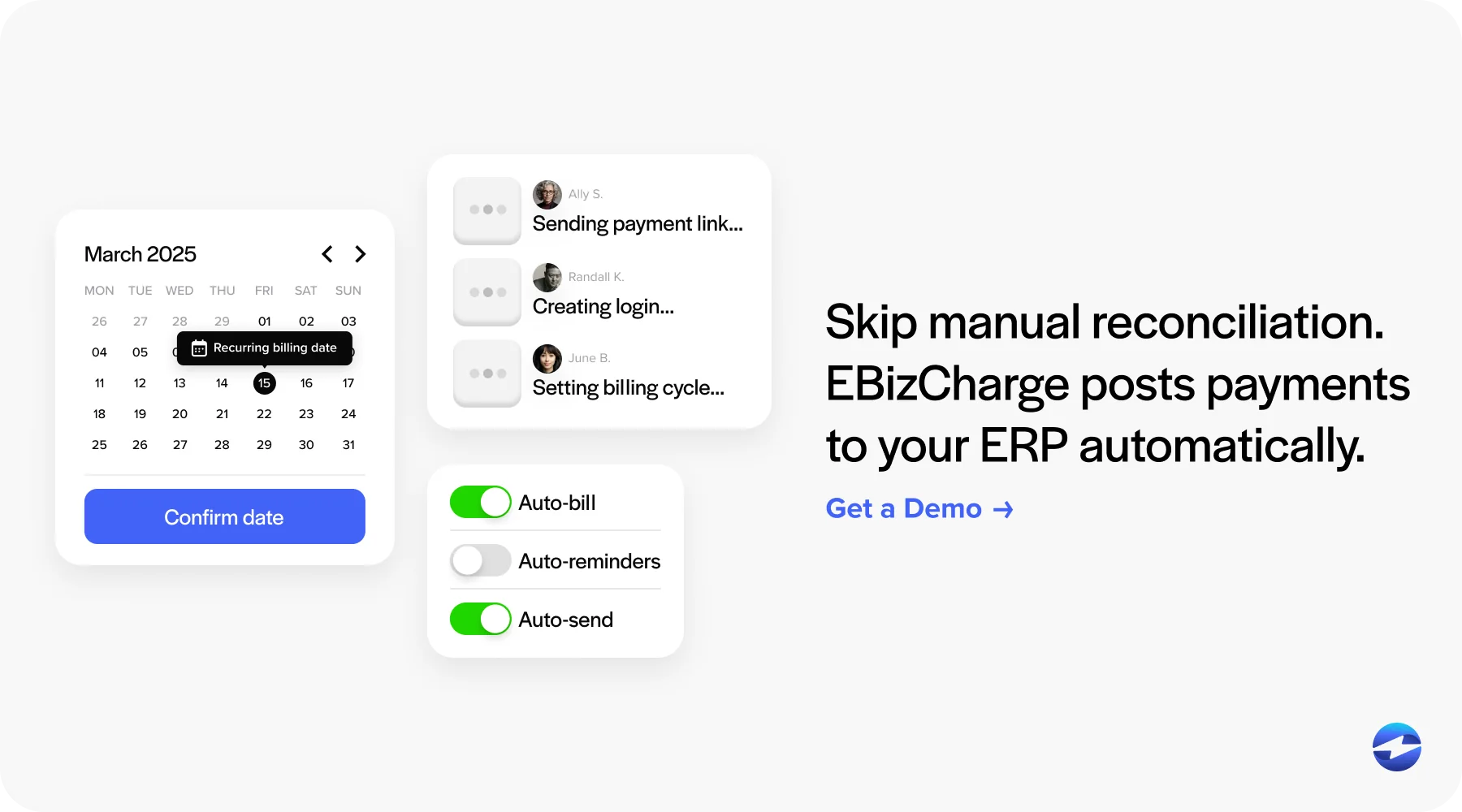
EBizCharge directly integrates with 100+ ERP, CRM, and accounting platforms, including QuickBooks, NetSuite, Sage, Salesforce, Microsoft Dynamics, SAP, and Acumatica. Rather than running payments through a separate system and reconciling them manually afterward, EBizCharge works inside the platforms your team already uses. When a customer pays, the payment posts directly to the correct invoice in your business system, with no manual entry required.
Beyond payment processing, EBizCharge gives AR teams a customer payment portal where clients can log in and pay outstanding invoices on their own, reducing the back and forth that drives up DSO. Automated payment reminders go out before and after due dates, so follow-ups happen consistently without manually tracking and sending them. For businesses running AR through one person, that kind of automation keeps the process moving even when the person’s attention is pulled elsewhere.
If your DSO is higher than you’d like, your AR visibility is limited, or your team is spending too much time chasing down past-due invoices, see what EBizCharge can do for your collections process. Request a free quote today.