
Blog > Best B2B Merchant Services Providers in 2026: Ranked for Mid-Market Companies
Best B2B Merchant Services Providers in 2026: Ranked for Mid-Market Companies

Most payment processors were built for businesses that sell to consumers. Fast checkout, simple card acceptance, maybe a basic invoicing tool. That works fine if you’re running a retail store or an e-commerce shop. But if you’re a mid-market manufacturer, distributor, or wholesaler trying to collect payments from other businesses, you are operating in a completely different environment — and most processors were not built for it.
The best B2B merchant services providers understand that B2B payment processing comes with a distinct set of requirements: high average transaction values, customers paying by ACH or corporate card, invoices tied to purchase orders, and accounting systems that need to reflect every transaction accurately and automatically. If your payment processor doesn’t handle those realities well, you end up with manual reconciliation, missed interchange savings, and an AR team that spends more time fixing problems than managing cash flow.
This guide is written for controllers, CFOs, and operations leaders at mid-market companies evaluating their options seriously. Here’s an honest look at what to prioritize and which providers are worth considering in 2026.
What Mid-Market B2B Companies Actually Need
Before getting into the rankings, it helps to understand the three capabilities that separate a capable B2B payment processing solution from one that just looks good on a feature list.
ERP Integration. Mid-market companies run their operations through ERPs — NetSuite, Microsoft Dynamics, Sage, QuickBooks Enterprise, SAP Business One. If your payment solution doesn’t connect natively to your ERP, you’re creating a manual reconciliation problem every single day. Someone on your team has to match payments to invoices, post transactions to the right accounts, and handle exceptions by hand. That’s expensive, slow, and error-prone. Native integration means payments post automatically, invoices close in real time, and your AR picture is always current.
Competitive Processing Rates. This one is genuinely under appreciated. Level 3 processing passes detailed transaction data — line item descriptions, PO numbers, tax amounts, freight charges — to the card networks when a business customer pays by card. In exchange, the card networks qualify those transactions for lower interchange rates, typically 0.5 to 1.5 percent less per transaction than standard rates. On a $50,000 invoice, that’s a real number. Most consumer-facing processors either don’t support Level 3 or require your team to manually input the required data fields, which defeats the purpose. A purpose-built B2B payment processing solution handles Level 3 automatically, capturing those savings without adding steps to your workflow.
AR Automation. Accepting payment is just one part of the accounts receivable cycle. The other parts — sending invoices, following up on overdue balances, applying payments to the right account, generating aging reports — are where mid-market companies lose significant time. Good payment processing software does more than process transactions. It automates reminders, gives customers a self-serve portal to view and pay invoices, and applies cash automatically so your AR team isn’t doing it manually. Reducing DSO (Days Sales Outstanding) is a CFO-level priority, and AR automation is one of the most direct levers for it.
Here it is. Our top payment processors for B2B merchants:
1. EBizCharge
EBizCharge sits at the top of this list because it’s the most comprehensively built payment processing solution for mid-market B2B companies. It’s not a consumer processor that also serves businesses on the side. B2B payment processing is what it was designed for, and that shows in nearly every feature.
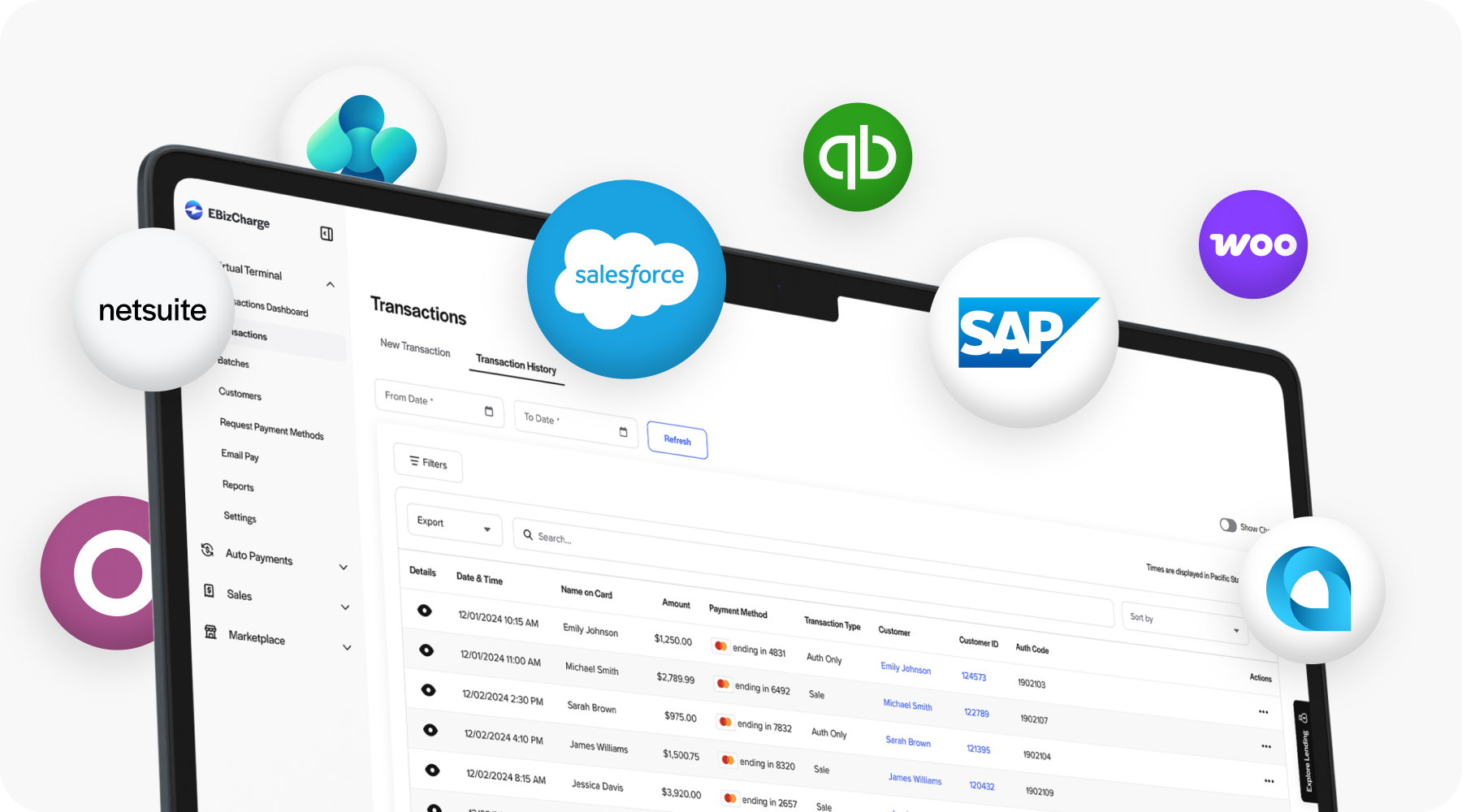
On ERP integration, EBizCharge has native connections to NetSuite, QuickBooks, Microsoft Dynamics, Sage, SAP, and several other platforms. Payments post automatically. Invoices close in real time. Partial payments, credit memos, and refunds are handled cleanly without manual intervention. If you’re running one of those ERPs, the integration works the way it should, not as a workaround.
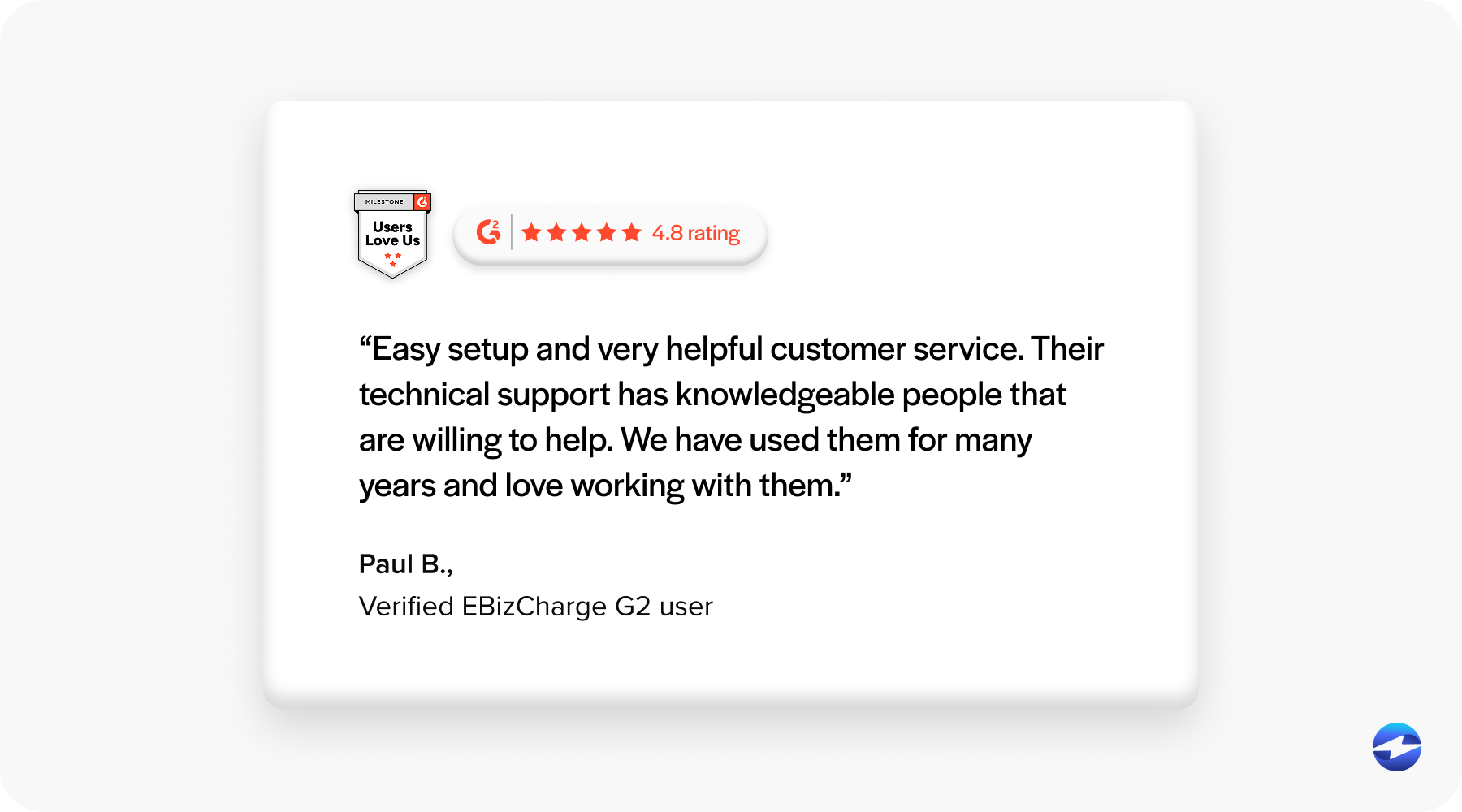
The AR automation layer includes a customer payment portal, automated invoice delivery, automated reminders, real-time reporting, and built-in surcharging capabilities for passing credit card processing costs to customers where legally permitted. EBizCharge consistently earns strong reviews on G2 and Capterra, particularly for integration quality, support responsiveness, and the experience for both the billing team and the customer. For mid-market companies that want a payment processor purpose-built for how B2B actually works, EBizCharge is the clearest choice on this list.
2. Versapay
Versapay is a strong option for mid-market companies that want to improve the payer experience. Its collaborative AR platform focuses on making it easy for customers to view, dispute, and pay invoices through a portal, which can meaningfully reduce friction in the collection process. It integrates well with NetSuite, Sage, and Microsoft Dynamics, and its AR automation capabilities are solid, particularly around dispute management and cash application.
Where Versapay falls short for some mid-market companies is that it’s primarily an AR platform rather than a full payment processing solution. Pricing and implementation complexity can also be a barrier for smaller mid-market companies that don’t have a large AR operation to justify the investment.
3. Billtrust
Billtrust is one of the most capable AR automation platforms available, with a strong order-to-cash workflow that handles invoice delivery, cash application, and dispute management at scale. Its ERP integrations are solid, and it supports various levels of processing within its payment acceptance layer.
The honest caveat with Billtrust is that it’s built for complexity. It’s a better fit for companies with large, high-volume AR operations than for mid-market companies with more straightforward needs. Implementation is involved, and the cost reflects that. If your AR operation is genuinely complex and you have the budget and IT resources for a larger deployment, Billtrust is worth consideration. If not, a more purpose-built B2B merchant services solution will likely serve you better.
4. Stripe
Stripe is one of the more technically flexible payment processors on this list, and for tech-forward companies with strong engineering resources, that flexibility is genuinely valuable. The API works, the documentation is thorough, and you can build nearly any payment workflow you want if you have the developers to do it.
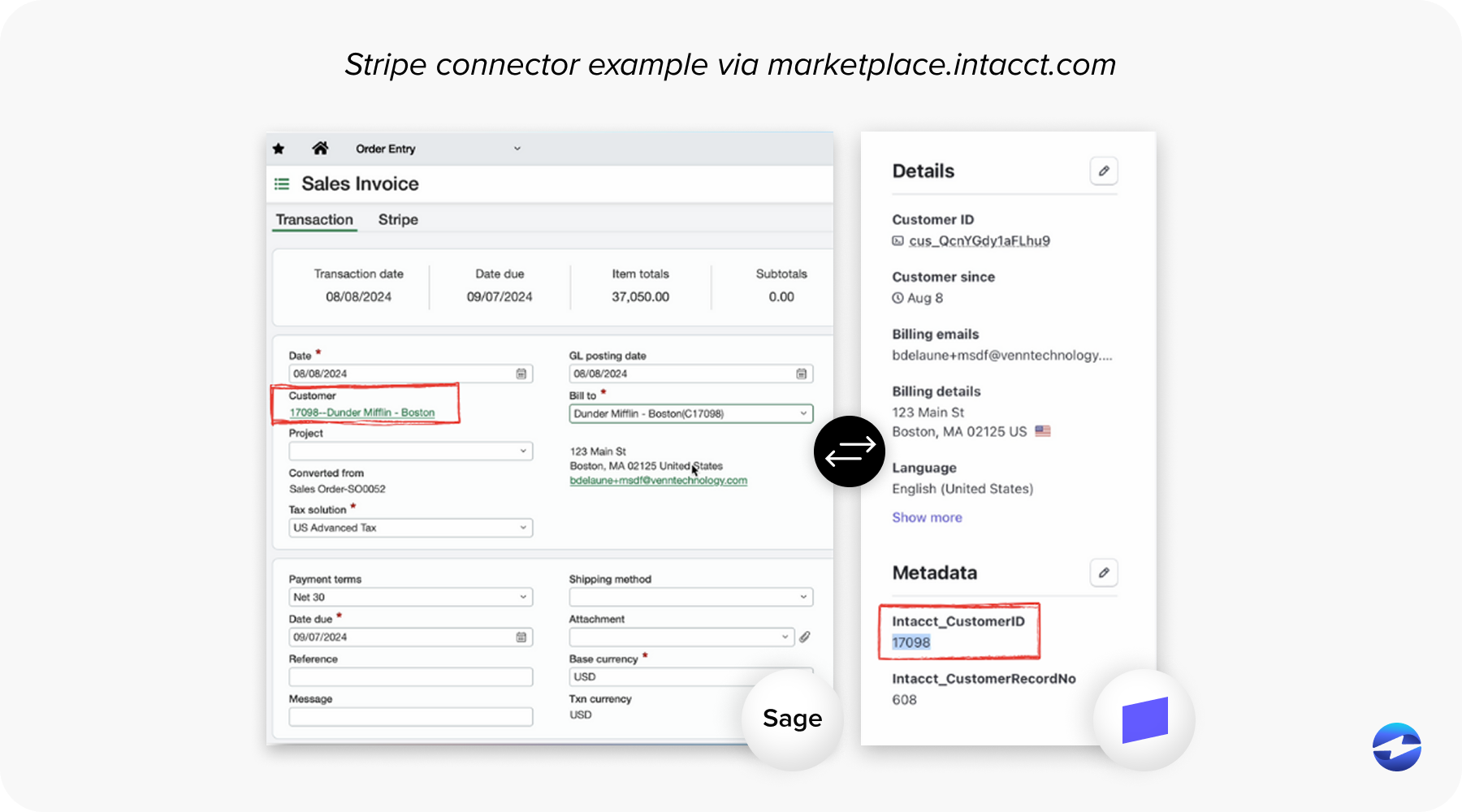
The challenge for mid-market B2B companies is that Stripe requires building. ERP integration isn’t native — it requires API work, middleware, or third-party connectors. AR automation in the traditional B2B sense isn’t one of Stripe’s strengths. If your company runs lean on technical resources and needs a payment processing solution that works out of the box with your ERP, Stripe is not the right starting point.
5. Authorize.Net
Authorize.Net has been around long enough that many mid-market companies already have experience with it, and that familiarity counts for something. It’s reliable, supports a wide range of processors, and handles credit card processing competently.
Where Authorize.Net shows its age is in ERP integration and AR automation. Native connections to major ERPs aren’t a strength, and AR automation features are limited compared to purpose-built B2B merchant services tools. Most companies using Authorize.Net at the mid-market level end up pairing it with other software to fill those gaps, which adds cost and complexity. It’s a workable gateway but not a complete B2B payment processing solution on its own.
How to Choose the Right Option
Start with your ERP. Before you evaluate any provider, know which systems you’re running and ask every vendor to demonstrate their integration live, not just describe it in a sales call. Ask specifically whether the integration handles automatic cash application, partial payments, and real-time posting.
Next, look at your transaction profile. If your average transaction size is high and customers pay by corporate card, Level 3 processing savings add up quickly. If most of your customers pay by ACH (Automated Clearing House), integration and AR automation become the more pressing priorities.
Finally, think honestly about the total cost. A payment processor with a slightly higher processing rate but native ERP integration and Level 3 will often be less expensive in total than a cheaper processor that requires manual reconciliation and misses interchange savings.
Why EBizCharge Is the Right Fit for B2B in 2026
The best B2B merchant services providers in 2026 are those built for B2B from the ground up, not adapted from consumer payment tools. EBizCharge meets that standard more completely than any other option on this list. Native ERP integrations, Level 3 processing, a real AR automation layer, built-in surcharging, and consistently strong reviews from the companies that actually use it. For mid-market companies that are ready to move beyond a generic payment solution and invest in payment processing software that fits how B2B actually operates, EBizCharge is the provider that consistently delivers.