

5 Best Payment Processing Solutions for Enterprise & Large B2B Companies in 2026


Large B2B organizations often juggle high payment and invoice volumes across multiple customers, departments, locations, and business entities. A process that worked at a smaller scale can quietly become a full-time headache once the business grows past it.
The right enterprise payment processing solution should scale with you, not create more manual work for your finance team every time you add a customer, a location, or a new product line.
In this guide, we’ll walk through five payment processing solutions built for enterprise and large B2B companies, what sets each apart, and how to figure out which one actually fits how your business operates.
The core question to keep in mind as you read: Can your payment process keep up as your business grows, or does every bit of growth mean more manual work?
Why Payment Processing Gets More Complicated as B2B Companies Grow
As B2B companies grow, the payment processes that once felt simple can become much harder to manage at scale. Here’s why:
More Volume Creates More Moving Pieces
As invoice and payment volume increases, finance teams often find themselves tracking more of everything: more payments, more invoices, more customer accounts, more exceptions, more transactions to reconcile.
A process that felt manageable with a hundred customers can become a genuine bottleneck once you’re serving a thousand.
B2B Payments Aren’t One Size Fits All
Your customers don’t all want to pay the same way. B2B payments can include everything from credit cards and ACH/eCheck to payments made directly from an emailed invoice. Some customers want a self-service portal where they can view their account whenever it’s convenient, while recurring customers may prefer to set it and forget it with Auto Pay.
Enterprise companies need to support these different payment experiences without turning AR into a juggling act.
Large Organizations Have More Systems and Teams Involved
At scale, payment workflows typically touch your ERP or accounting system, multiple departments, several locations, possibly multiple business entities, and more than one payment channel.
When those systems aren’t talking to each other, someone on your team is stuck manually moving information between them, and that time adds up fast. Recent Federal Reserve research highlights this challenge, finding that disconnected payment and remittance data can require AR teams to manually match incoming payments with the information needed to reconcile them.
7 Things to Look for in an Enterprise Payment Processing Solution
Before comparing specific platforms, it helps to know what you’re actually evaluating them against.
1. ERP and Accounting Integration
Look for a solution that connects directly with the financial systems you already use. The key question: when a customer pays, how does that information actually get into your ERP or accounting system? If the answer involves someone typing it in, that’s a problem.
2. AR Automation
Look at what your team still has to do once a payment comes in. If someone has to find the invoice, apply the payment, and update the financial system by hand, those extra steps can add up quickly across thousands of transactions. AR automation can take some of that repetitive work off the team’s plate.
3. Flexible Payment Options
Your customers have their own AP processes, and they won’t all want to pay the same way. One may prefer ACH or eCheck for a large invoice, while another uses a corporate card or pays directly from an invoice. Look for a solution that gives customers flexibility without creating separate payment workflows for your AR team.
4. Scalability
Consider what changes for your AR team as the business grows. If every increase in payment volume brings more manual posting, invoice matching, and reconciliation, the current process may become harder to maintain at scale.
5. Support for Complex Organizations
Enterprise businesses need a solution that can handle multiple entities, locations, departments, users, and large customer and invoice volumes without falling apart at the seams.
6. Security and Fraud Protection
Payment data may pass through several systems before a transaction is fully recorded and reconciled. Consider how that information is protected along the way and who can access it. PCI compliance is an important starting point, along with safeguards that reduce exposure of sensitive payment data.
7. Reporting and Visibility
Your finance team should be able to see payment activity, outstanding invoices, exceptions, customer payment history, and reconciliation status clearly, without exporting five spreadsheets to piece it together.
Top Payment Solutions for Enterprise & Large B2B Companies Compared Side-by-Side
| Feature |  |
 |
 |
 |
 |
|---|---|---|---|---|---|
| Best for | Enterprises wanting payments inside their ERP | Multi-channel enterprises | Tech-driven enterprises | High-volume processors | Large digital businesses |
| What sets it apart | Prebuilt ERP connectors, no custom work | Omnichannel platform and enterprise APIs | API and dev tools | Enterprise processing infrastructure | Payment routing and optimization |
| ERP posting and invoice matching |  |
 |
|
|
|
| Customer payment portal | |
 |
 |
|
|
| Recurring billing and Auto Pay | |
|
|
|
|
= Partial, varies, or needs partner or custom work
Scroll to compare 
5 Best Payment Processing Solutions for Enterprise & Large B2B Companies
1. EBizCharge
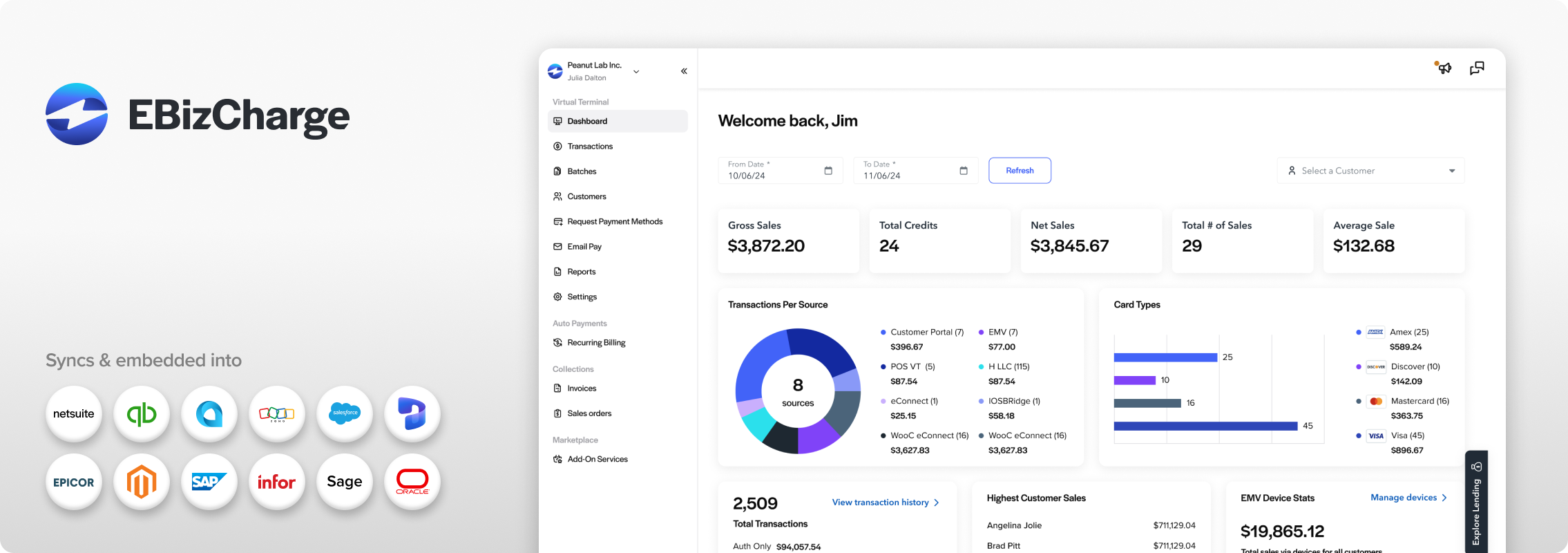
Best for: Enterprise and large B2B companies that want payment processing built directly into their ERP, accounting, and AR workflows, not bolted on beside them.
Key Features:
- ERP, accounting, CRM, and ecommerce integrations
- Credit/debit and ACH/eCheck payments
- Customer payment portal
- Email Pay and payment links
- Recurring billing and Auto Pay
- Automated invoice matching
- Automatic payment posting and reconciliation
- Multi-entity payment capabilities
- Centralized reporting
- PCI compliance, tokenization, and encryption
- Fraud prevention and chargeback tools
- U.S. based support
2. Adyen
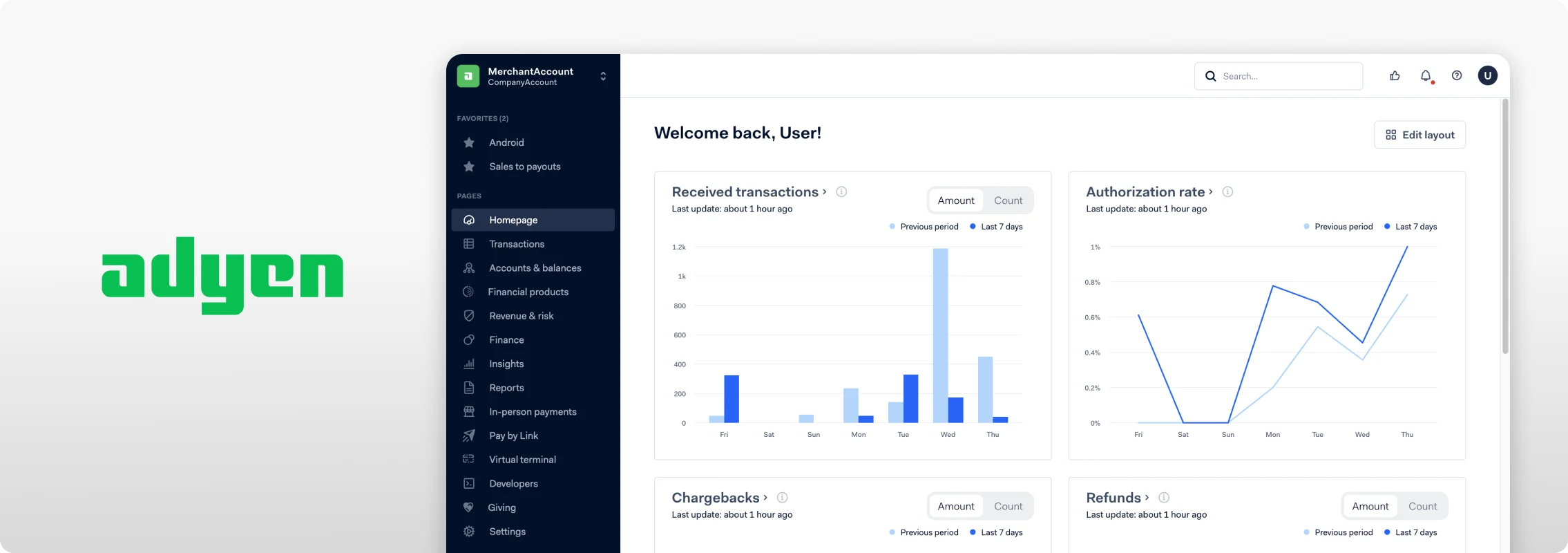
Adyen screen via docs.adyen.com
Best for: Large businesses managing payment experiences across multiple sales channels.
Key Features:
- Online and in-person payments
- Omnichannel capabilities
- Enterprise APIs
- Fraud and risk management tools
- Payment optimization
- Reporting and reconciliation
3. Stripe
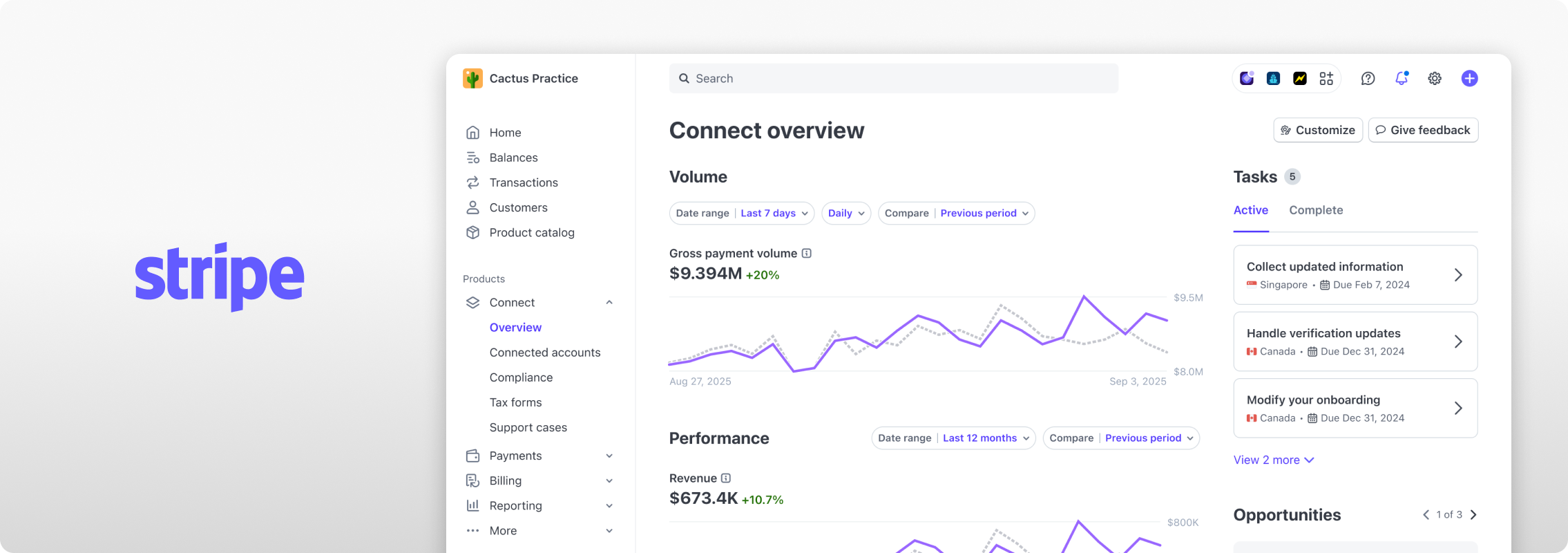
Stripe screen via stripe.com
Best for: Technology-driven enterprises that want customizable payment infrastructure.
Key Features:
- Extensive APIs
- Online payment acceptance
- Invoicing
- Recurring and subscription billing
- Automated payment reminders
- Reporting and data tools
- Platform capabilities
4. Worldpay

Worldpay screen via totalpayments.co.uk
Best for: Large organizations processing significant transaction volume.
Key Features:
- Online and in-person payments
- Omnichannel capabilities
- Fraud and authentication tools
- Payment optimization
- Enterprise payment infrastructure
- Reporting
5. Checkout.com

Checkout screen via Checkout.com
Best for: Large digital businesses looking for flexible online payment infrastructure.
Key Features:
- Online payment acceptance
- APIs
- Payment routing
- Fraud and risk tools
- Payment optimization
- Reporting and payment data tools
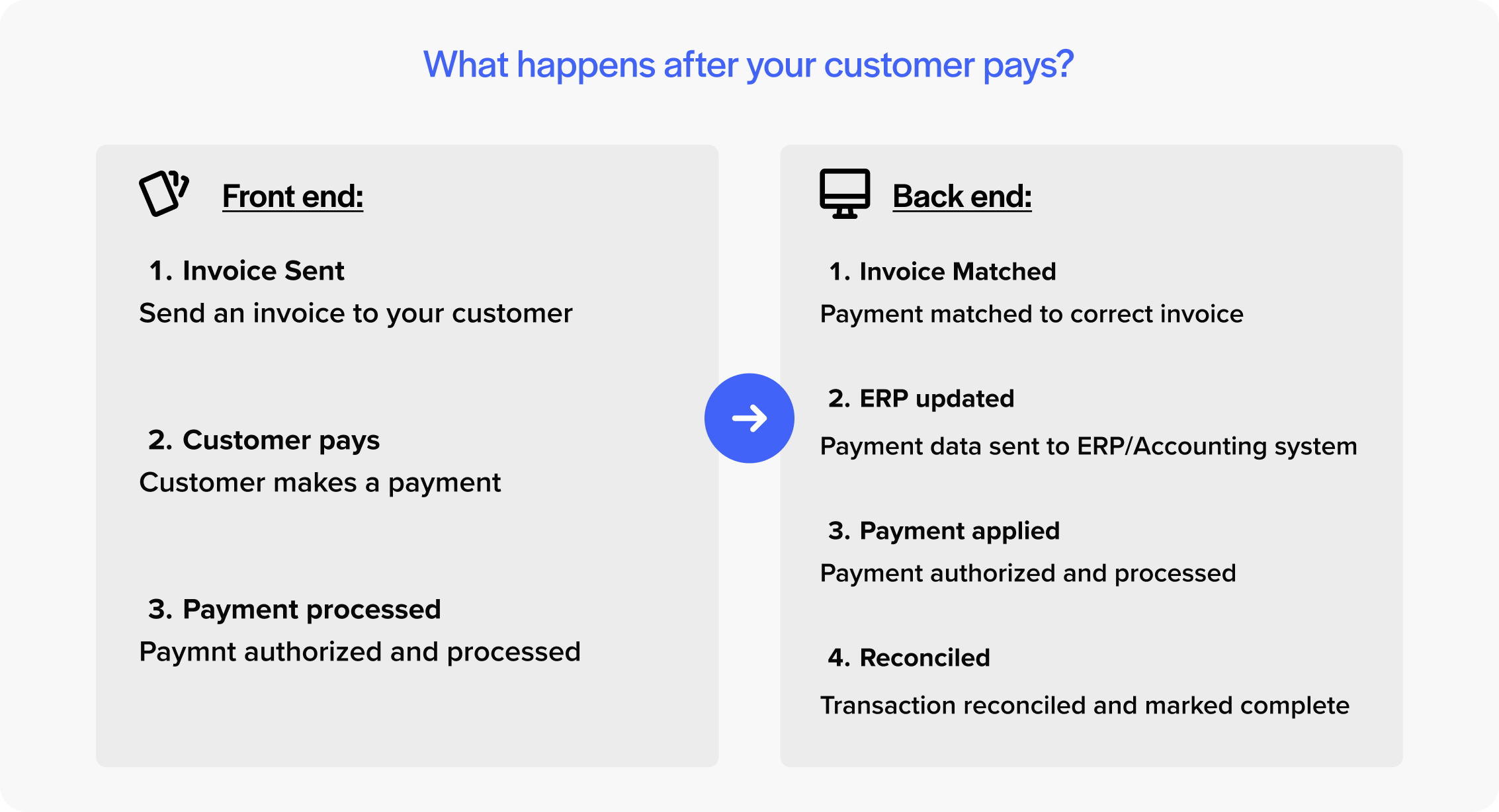
What Happens After Your Customer Pays?
Many payment comparisons focus on getting the transaction approved. But for enterprise finance teams, that’s only step one. For enterprise finance teams, a whole chain of events must happen after that before the payment is actually done.
The typical path looks like this:
If several of those steps require someone to move or enter information manually, then every bit of payment volume growth means more manual work for your team, not less.
A quick self-check. Ask yourself:
- Do you manually enter payments into your ERP?
- Does your team manually match payments to invoices?
- Are employees switching between systems to manage payment information?
- Does reconciliation get harder as payment volume grows?
- Do you still handle recurring payments by hand?
If several of these sound familiar, the real challenge probably isn’t accepting payments. It’s everything that happens after.
How to Choose the Right Enterprise Payment Processing Solution
Choosing the right enterprise payment processing solution starts with understanding how it fits into your current operations and where your business is headed.
You don’t need to overhaul everything at once. Start with the areas creating the most friction for your team, then look for a solution that can address those gaps without disrupting the systems and processes that already work.
Simplify Enterprise B2B Payments With EBizCharge
As your business grows, processing more payments shouldn’t automatically mean spending more time managing them.
That’s where EBizCharge comes in. EBizCharge combines payment processing with tools built specifically to simplify B2B accounts receivable. Enterprise businesses can accept credit, debit, and ACH/eCheck payments, give customers flexible payment options, automate recurring billing, and connect payment activity directly to supported ERP and accounting systems.
Instead of leaving the finance team to sort out payment activity at month-end, EBizCharge connects payments with supported ERP and accounting systems so more of that information reaches the right place automatically. That can mean less time spent matching payments, updating records, and figuring out what still needs attention.
Make it easier to get paid, without creating more work for your finance team.
See how EBizCharge can simplify your enterprise payment workflow.
Frequently Asked Questions About Enterprise Payment Processing
What is enterprise payment processing?
It’s how large organizations accept and manage payments at scale, covering payment acceptance, system integrations, automation, security, and reporting, not just the transaction itself.
What is the best payment processing software for big companies?
For a large B2B company, start with what happens after a customer pays. If the finance team still has to manually update invoices, enter payments into the ERP, or sort through transactions during reconciliation, the software may not be solving enough of the payment process. Look for a solution that fits into the systems and workflows your team already relies on.
How is B2B payment processing different from consumer payment processing?
B2B payments tend to involve invoicing, ACH/eCheck, recurring payments, larger transaction sizes, and a direct tie-in to ERP or accounting workflows and reconciliation, things most consumer checkout flows never have to deal with.
Can enterprise payment processing integrate with an ERP?
Yes. Integrated payment solutions can connect payment activity directly with supported ERP and accounting systems, so transactions don’t have to be manually re-entered.
Can enterprise businesses automate payment reconciliation?
Yes. When payment activity flows back into the ERP or accounting system, the transaction can be tied to the appropriate invoice instead of leaving the finance team to sort it out later. How much of that process can be automated depends on the payment solution and its integration with your financial system.
What is an enterprise payment gateway?
It’s the technology that securely processes a payment transaction. For larger businesses, security, reliability, integration capability, and scalability matter far more than they do for a small storefront.
How can large B2B companies reduce manual AR work?
Start with the steps your team repeats for nearly every payment. If employees are constantly matching transactions to invoices or updating the ERP after customers pay, connecting those steps can save a significant amount of time as payment volume grows.
Get paid faster with less work.
Get paid faster with less work.
3-minute product overview