



Most auto repair shop owners didn’t get into the business to think about payment technology. You got into it because you’re good with automotive mechanics, good with customers, and good at solving problems other people can’t. But at some point, getting paid becomes its own problem — and the payment processing solution you’re using either makes that easier or harder every single day.
This guide is for shop owners, service managers, and anyone running the front desk who wants payment processing that actually fits how a shop works — not a system designed for coffee shops or online stores, but something built for the real variables of automotive service: big tickets, changing estimates, remote customers, and fleet accounts.
Why Auto Repair Shops Have Unique Payment Needs
Payment processing for auto repair shops isn’t the same as payment processing for retail. The transaction sizes are bigger, the payment scenarios are more varied, and the back-office requirements are more specific. A system that works fine for a boutique or a restaurant will leave gaps in a shop environment.
Start with ticket size. The average repair order runs $400 to $600 or more, and a flat rate processor charging 2.9% plus $0.30 per transaction is taking $12 to $18 off the top of every job. That’s before you get to transmission work, engine repairs, or anything involving significant parts. Processing fees that feel manageable on a $50 transaction become a real cost at $800.
Then there’s the way repair orders evolve. A customer brings in a car for a brake job, and you find a leaking caliper mid-inspection. The estimate changes. The final invoice is different from what the customer approved over the phone. A good payment processor needs to handle updated amounts gracefully, without creating confusion or friction at pickup.
Remote payment is another piece that’s specific to the automotive industry. Many customers aren’t standing at the counter when it’s time to pay. They dropped the car off in the morning and want to pay by phone or text link before pickup. If your payment solution can’t handle that, you’re either waiting for them to show up or collecting card numbers over the phone manually.
Fleet accounts add another dimension. Commercial customers — contractors, delivery companies, small businesses with several vehicles — often pay on net terms by ACH (Automated Clearing House) or check. That’s a completely different workflow from a consumer swiping a card at the terminal, and the right payment processing for auto shops covers both without requiring separate systems.
The Real Cost of the Wrong Setup
The hidden cost of a mismatched payment system isn’t obvious on any single day. It shows up over time, transaction by transaction.
If your payment processor sends one lump-sum deposit to your bank account each day, someone has to match that deposit to the individual repair orders that make it up. For a shop doing 20 to 40 jobs a week, that reconciliation work adds up — time your service advisor isn’t spending on anything that moves the business forward.
Processing fees are the other side. Flat rate pricing sounds simple, but it’s rarely the most cost-effective choice for shops processing large-ticket jobs at volume. Interchange-plus pricing, where you pay the actual interchange rate plus a small processor margin, is generally cheaper when average transaction values are high. Across a full year of repair orders, that difference adds up.
Then there are chargebacks. A customer disputes a charge, claims the work wasn’t authorized, and suddenly, you’re dealing with a payment processor that may or may not have tools to help you defend it. Shops with clean digital records tied to signed repair orders resolve disputes far more easily than shops relying on paper.
What to Look for in a Payment Processor
When you’re evaluating payment processing options, the feature lists all start to look similar. Here’s what actually matters for an auto repair shop specifically.
The first thing is integration. The best payment processing software for auto shops connects directly to whatever platform you’re using to manage repair orders and accounting. If every payment still requires a manual entry somewhere else, you haven’t eliminated the double-work — you’ve just moved it.
Text-to-pay matters more than most shops realize until they have it. When a customer is at work and can’t take a call, a text link they can tap and pay in thirty seconds is a better experience than a phone call where someone reads a card number out loud in a meeting room. It also removes the liability of your staff handling card data over the phone.
ACH support also belongs on this list. Fleet customers and commercial accounts often expect to pay by bank transfer, and ACH fees are significantly lower than credit card rates. A payment solution that handles both in the same system keeps your workflow lean.
Surcharging is worth understanding. In most states, it’s legal to pass credit card fees to customers as a line item on the invoice. For a shop doing several hundred dollars per job, that protects real margin. Not every processor supports it cleanly, so ask directly.
Finally, pricing transparency. Ask any processor to explain their fee structure in plain terms. Interchange-plus is more favorable than flat rate for high-ticket service businesses. If a vendor is vague about how fees are calculated, that’s information too.
The Best Payment Processing Options for Auto Repair Shops
| Feature |  |
 |
 |
|---|---|---|---|
| Pricing model |  Interchange-plus Interchange-plus
Negotiated by volume |
 Flat rate Flat rate
Less effective for high-volume |
Flat rate
Less effective for high-volume |
| Accounting integration | 100+ native integrations
To ERP, CRM, and more systems |
Connector
Connect to some ERPs |
 Not included Not included
Third-party connectors only |
| Surcharging | Included
Available with platform |
In beta
Maybe available |
Included
Available with platform |
| Recurring billing | Included
Customize time frames |
Limited
Basic subscriptions only |
Included
Robust subscription options |
| In-person terminal | Available
Wireless & countertop, compatible with most brands |
Included
Square Terminal Reader, Register |
Included
Robust Stripe Reader M2, BBPOS WisePOS E |
| Support | US-based, 24/7
Dedicated to your team |
Included
Phone, chat, and email |
Included
Phone for high-volume only |
Scroll to compare 
Here’s an honest look at what’s available in the automotive industry, starting with the strongest fit.
EBizCharge
EBizCharge is a great choice for payment processing for auto repair shops, and one of the clearest examples of payment processing for auto shops done right. What separates it from the general-purpose options is that it was built for businesses that live inside accounting and business management software. That architecture matters when you need payment data to flow cleanly into QuickBooks, Sage, Microsoft Dynamics, NetSuite, or Acumatica without manual entry.
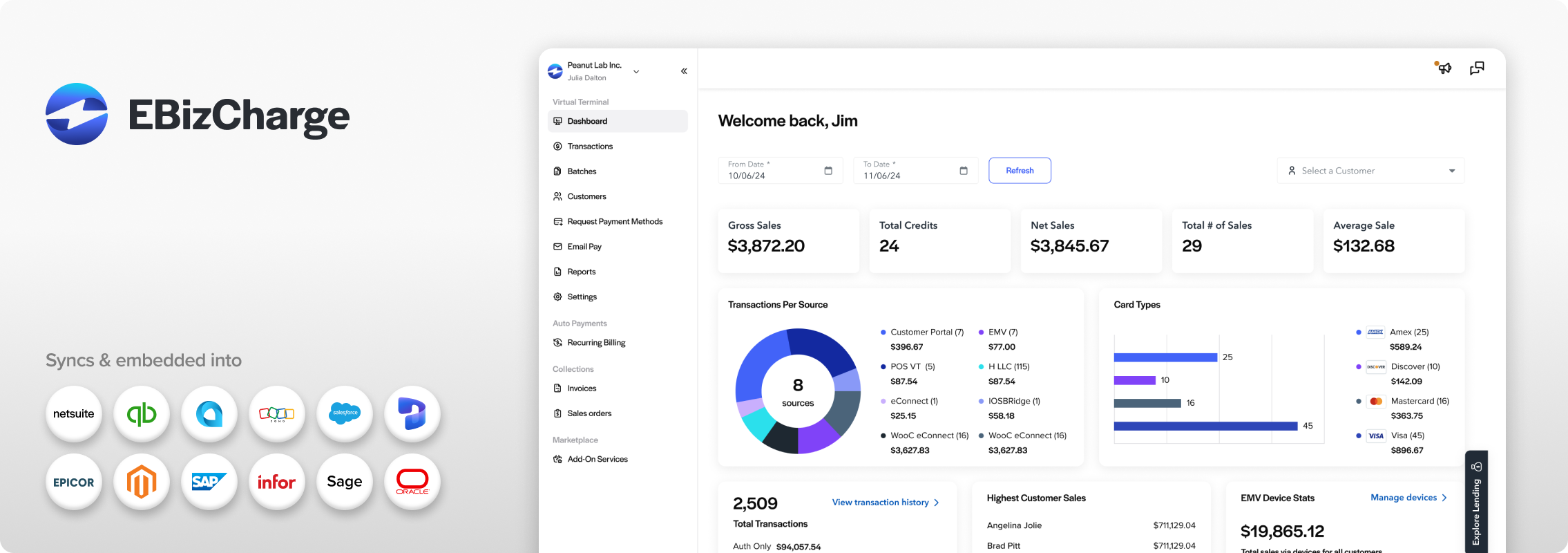
EBizCharge covers the full range of what a shop needs. Text-to-pay and remote payment links are built in, so customers can pay from their phone without requiring staff involvement. Card-on-file works for repeat customers and fleet accounts. ACH is supported natively alongside credit card processing, and surcharging is available where state law permits. Pricing can offer an interchange-plus model rather than flat rate, which is more cost-effective for shops processing at higher ticket values. Each payment ties back to a specific invoice, not just a deposit, which makes reconciliation automatic rather than manual.
For shops frustrated by payment processing software that promises integration but delivers only a CSV export, EBizCharge is where the search tends to end.
Square
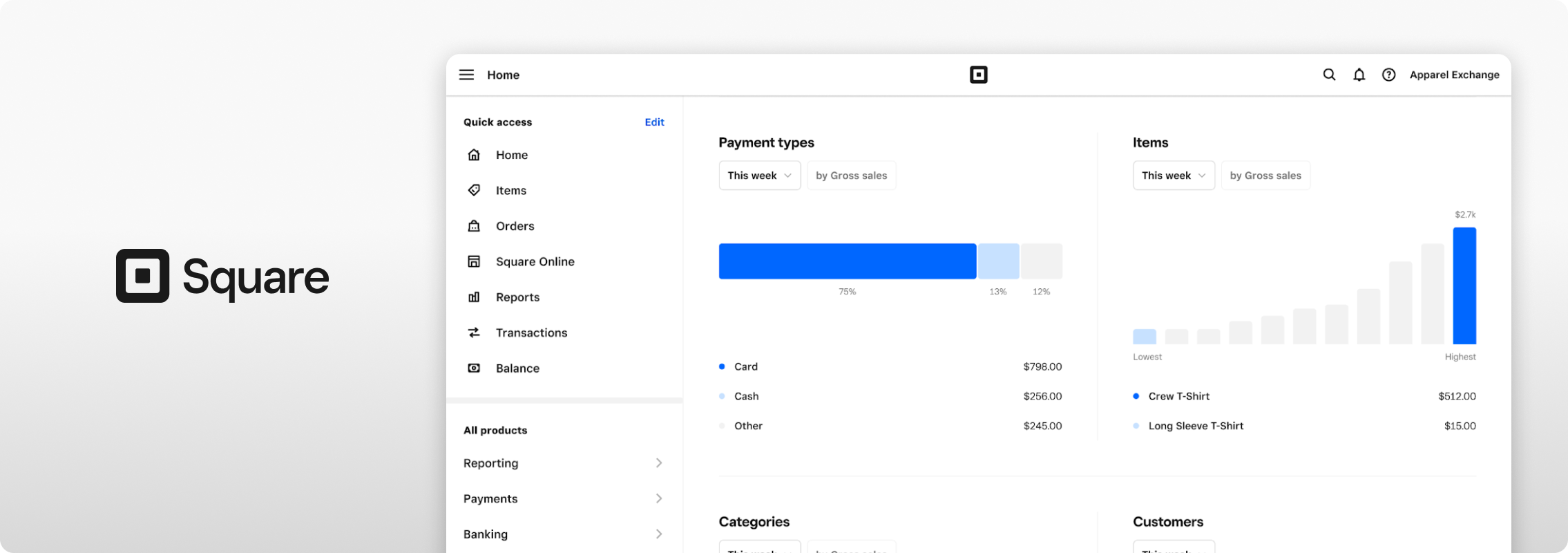
Square screen via squareup.com
Square is accessible and easy to start with. For a very low-volume shop that needs something simple, it works. But flat rate pricing becomes expensive as ticket sizes grow, and the accounting integration isn’t deep enough to eliminate manual reconciliation for most shops.
Stripe
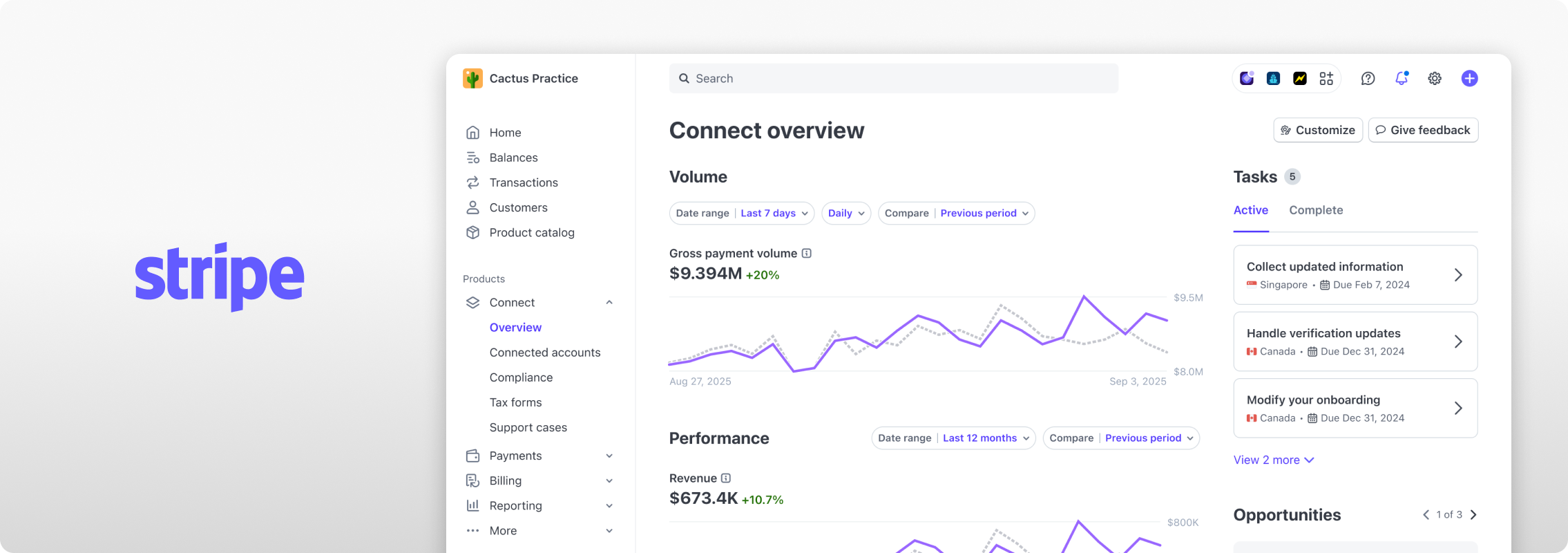
Stripe screen via stripe.com
Stripe has solid infrastructure and is developer-friendly, but it’s built for businesses with technical resources to configure it. Out of the box, it doesn’t map to a shop workflow without custom setup.
Shop management platforms with built-in payments
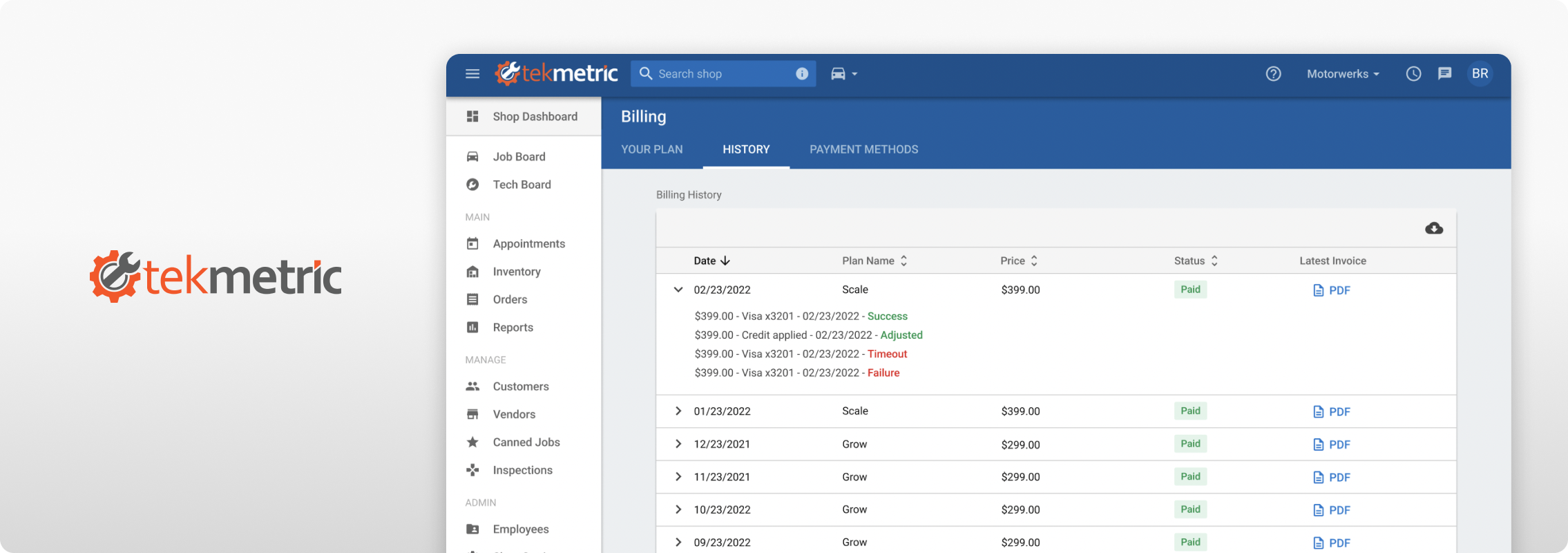
Tekmetric screen via tekmetric.com
Shop management platforms with built-in payments, like Tekmetric or Shop-Ware, offer tight in-platform integration. The limitation is that payment functionality is secondary to their core product, and accounting integration outside their ecosystem tends to be limited.
Making the Switch Without Disrupting Your Operation
The main reason shops stay with a processor that isn’t working well is fear of disruption. The transition is more manageable than it feels.
Start by mapping your current transaction mix: who pays by card at the counter, who pays by text link, which fleet accounts pay by ACH. That inventory tells you what workflows need to be ready before you go live.
Move fleet accounts carefully. They’re on billing schedules and may have your current banking details saved. Communicate the change early and give them a window where both options are available.
Test the accounting integration before going fully live. Run a handful of transactions and trace them through your accounting software. Confirm the GL mapping is correct. A configuration issue caught now is far easier to fix than incorrect entries unwound later.
Why EBizCharge Is the Right Payment Processing Solution for Auto Repair Shops
Auto repair shops deal with payment scenarios that most processors weren’t designed for: large and variable transactions, customers who pay remotely, fleet accounts on net terms, and back-office systems that need clean data rather than lump-sum deposits.
EBizCharge resolves each of those problems in one platform. The best payment processing software for a shop isn’t the one with the most features — it’s the one that fits your workflow without asking your team to work around it. Payment processing software for auto shops specifically needs to handle variable invoices, remote customers, and fleet billing without those things living in separate tools. EBizCharge fits. The integration is native, the pricing is transparent, the remote payment tools are built in, and the reconciliation is automatic.
When you’re looking at payment processing for mechanics and want something that holds up across a busy week of varied jobs and customer types, EBizCharge is the right answer. Good payment processing for mechanics means the system handles the job from remote authorization to GL posting without anyone babysitting it. EBizCharge does that. If you’re ready to stop working around your payment system and start working with one, that’s where to start.
Get paid faster with less work.
Get paid faster with less work.
3-minute product overview