
Blog > Merchant Services for Dentists: Choosing the Right Payment Processor for Your Practice
Merchant Services for Dentists: Choosing the Right Payment Processor for Your Practice

Choosing a payment processor feels like it should be straightforward. Pick a provider, set up a terminal, and start accepting cards. For most businesses, that’s roughly how it works.
For dental practices, it’s more complicated. The way patients pay for dental care — large treatment balances, split payments across visits, insurance coordination, financing plans, FSA cards — doesn’t fit neatly into what most payment processors are designed to handle. And the practices that find this out the hard way often do so after a transaction gets held, a payment plan breaks down, or a billing reconciliation turns into a two-hour headache for the front desk.
This guide is for dentists, office managers, and practice administrators who want to make a smart, informed decision about merchant services for dental offices. It covers what to look for, what to avoid, and what questions to ask before you sign anything.
What Makes Dental Different from Other Merchant Categories?
Before getting into what to look for in a payment processor, it helps to understand why dental payment processing is a different animal altogether.
Most businesses run a high volume of small transactions. A restaurant, a retail store, a service shop — they process dozens or hundreds of transactions a day, most well under a few hundred dollars. Payment processors build their pricing models and risk frameworks around that profile.
Dental practices work differently. Transaction volume is lower, but individual transactions are much larger. A crown or implant can run several thousand dollars. Full-arch reconstructions and comprehensive orthodontic cases can reach $15,000 or more. When a processor calibrated for a coffee shop sees a $9,000 charge come through a dental account, it can trigger an automatic hold, a fraud review, or worse.
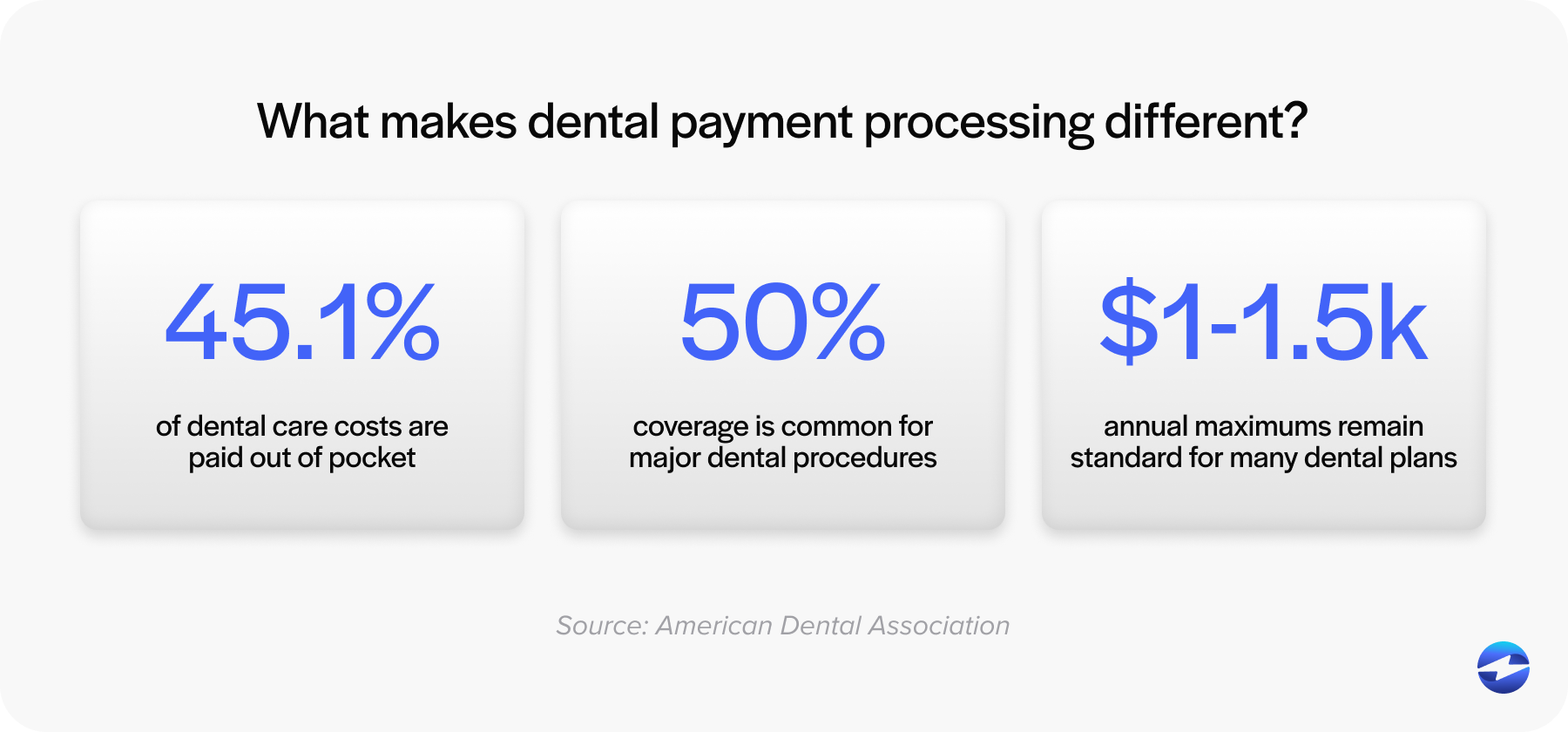
Beyond ticket size, dental offices also deal with a genuinely mixed payment environment. On any given day, a front desk team might collect a copay from an insured patient, run an FSA card for a hygiene visit, bill a recurring monthly installment on a treatment plan, and process a deposit for a case that hasn’t started yet. That kind of complexity requires payment processing software built specifically for healthcare, not a basic terminal designed for retail.
Red Flags to Watch for In a Payment Processor
If you’re evaluating merchant services for dentists, these are the warning signs worth knowing before you commit.
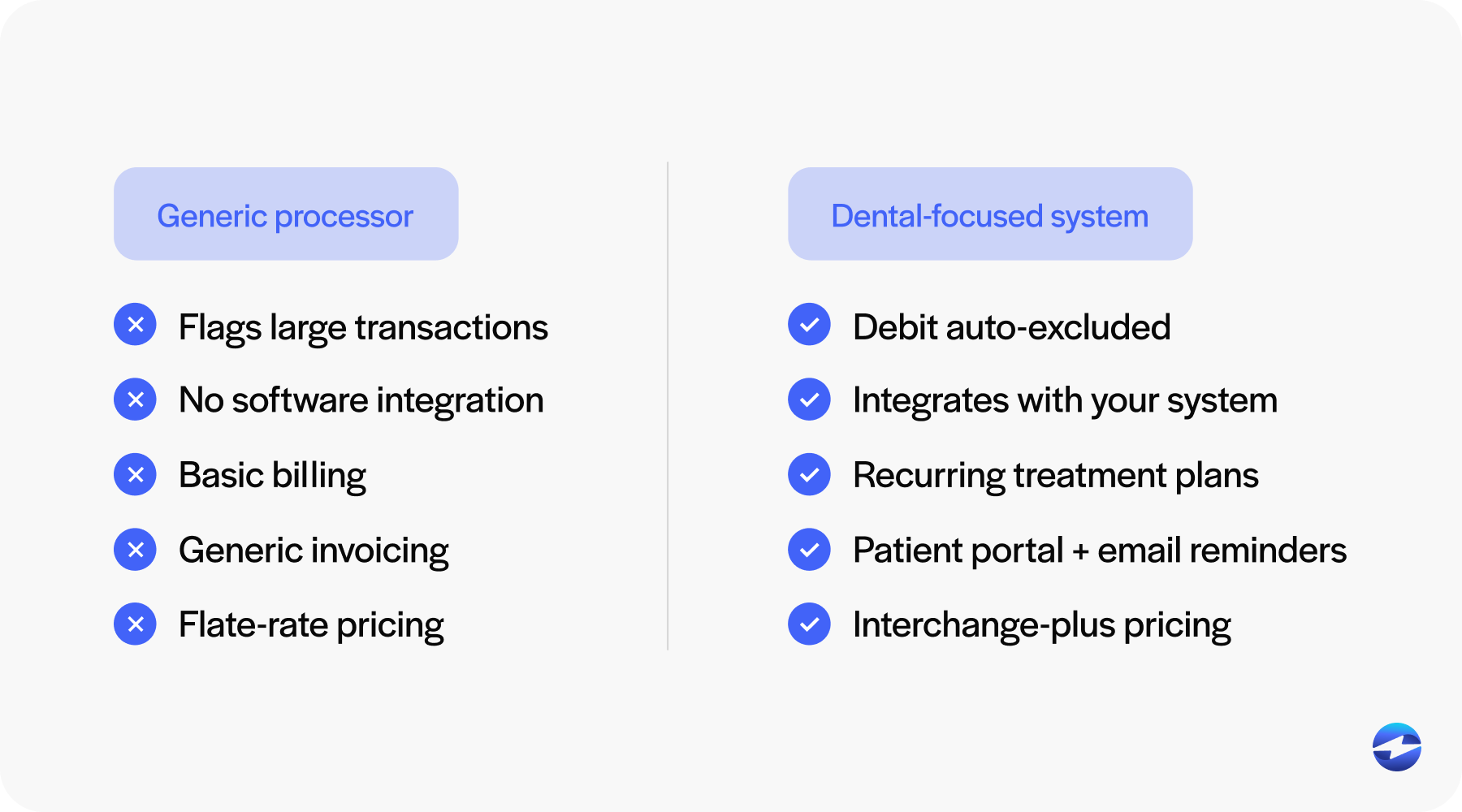
No dental or healthcare underwriting experience. This is the big one. A processor that doesn’t regularly work with dental practices hasn’t built its risk models around your transaction patterns. Large payments get flagged, funds get held, and you end up explaining your own legitimate business to a support rep with no context.
Rolling reserves. Some processors require high-ticket merchants to hold back a percentage of monthly revenue as a security buffer. For a busy practice, this can quietly drain a meaningful amount of working capital. Always ask upfront whether reserves apply.
Flat-rate pricing. Flat-rate pricing can work for low-volume businesses with small transactions. For a dental practice processing large amounts, it almost always costs more than interchange-plus pricing. The math simply doesn’t work in your favor.
No recurring billing capability. If a processor can’t store cards on file and charge them automatically, it can’t support in-house payment plans. This feature needs to be native to the platform, not a workaround.
Long contracts and steep termination fees. A processor confident in its product doesn’t need to lock you in for three years with a hefty exit penalty. If the contract feels designed to trap you, it probably is.
Weak practice management integrations. A payment portal that doesn’t connect to Dentrix, Eaglesoft, Open Dental, or Curve means your team is re-entering data and reconciling across systems every day.
Features Every Dental Merchant Services Provider Should Offer
Dental practice owners and office managers who have dealt with the wrong payment setup know exactly how much the right one matters. Here’s what a genuinely capable merchant services provider should bring to the table.
High-ticket underwriting. Your processor should understand dental transaction sizes before your first payment goes through, not after. This means they’ve specifically approved your account for the volume and ticket sizes typical of a dental practice.
Built-in recurring billing. Card-on-file billing, automatic payment scheduling, and tokenized storage of patient payment data should all be part of the core platform. This is the infrastructure behind in-house payment plans and membership programs.
Virtual terminal and text-to-pay. Not every balance gets collected at the chair. A virtual terminal lets your team process payments over the phone or by email, and text-to-pay lets patients settle balances from their phone without calling the office. Both reduce outstanding receivables significantly.
FSA and HSA card acceptance. Most dental services are eligible expenses under flexible and health spending accounts. Your payment processing solution should accept these cards without friction, including automatically handling IIAS eligibility requirements.
Direct practice management integration. When your payment portal connects directly to your practice management software, balances update automatically, reconciliation takes minutes instead of hours, and your team isn’t working across two separate systems.
Transparent interchange-plus pricing. With interchange-plus, you pay the actual card network cost plus a fixed processor margin. There are no tiers, no rate bucketing, and no surprises. At dental transaction volumes, this model consistently costs less than flat-rate alternatives.
PCI-compliant infrastructure. Any payment processing software worth considering should use encryption and tokenization to protect cardholder data. This keeps patient payment information secure and keeps your practice out of compliance trouble.
Understanding What You’re Actually Paying
Pricing transparency is one of the clearest ways to tell a strong processor from a weak one.
There are three common pricing models worth knowing. Flat-rate pricing charges the same percentage on every transaction regardless of card type. It’s predictable, but expensive for high-ticket merchants. Tiered pricing groups transactions into qualified, mid-qualified, and non-qualified buckets, with different rates for each. Large or manually keyed transactions almost always land in the most expensive tier, which is bad news for dental.
Interchange-plus pricing is the most transparent model and typically the best payment processing solution for dental payment processing. You pay the actual interchange rate set by the card network, plus a fixed markup from your processor. You can see exactly what you’re paying and why.
Beyond the base rate, ask specifically about PCI compliance fees, monthly minimums, statement fees, and batch fees. A processor that gives you a full breakdown without being asked is a good sign. One that buries fees in the contract is not.
Why Payment Processing Is a Case Acceptance Issue, Not Just a Billing Issue
This is something dental practice owners don’t always consider until it becomes obvious. The way your practice collects payments directly affects whether patients say yes to treatment.
When a patient is sitting across from you after a treatment presentation, cost is almost always part of the conversation. The easier it is to offer flexible payment options at that moment, the more likely that patient is to move forward. A payment solution with built-in financing options, easy recurring plan setup, and a smooth digital experience removes friction at exactly the right time.
On the back end, the impact is just as real. Text-to-pay and automated billing reminders reduce outstanding balances that your team has to chase. Automatic payment retries handle failed transactions without anyone having to pick up the phone. Good merchant services for dental offices quietly reduce the administrative load on your front desk every week.
The right payment setup doesn’t just process transactions. It supports your practice’s ability to provide care.
Questions to Ask Before Choosing a Payment Processor
It’s important to know what you’re getting when choosing a payment processor. So, here are some questions to ask when vetting any merchant services provider. The answers will tell you quickly whether they actually understand dental.
Choose a Payment Processor That Understands Dental, Like EBizCharge
The right merchant services provider for the dental industry doesn’t just process payments. It reduces friction, supports your team, and helps your practice run more smoothly. The wrong one costs you in ways that aren’t always obvious until you’re deep into the relationship.
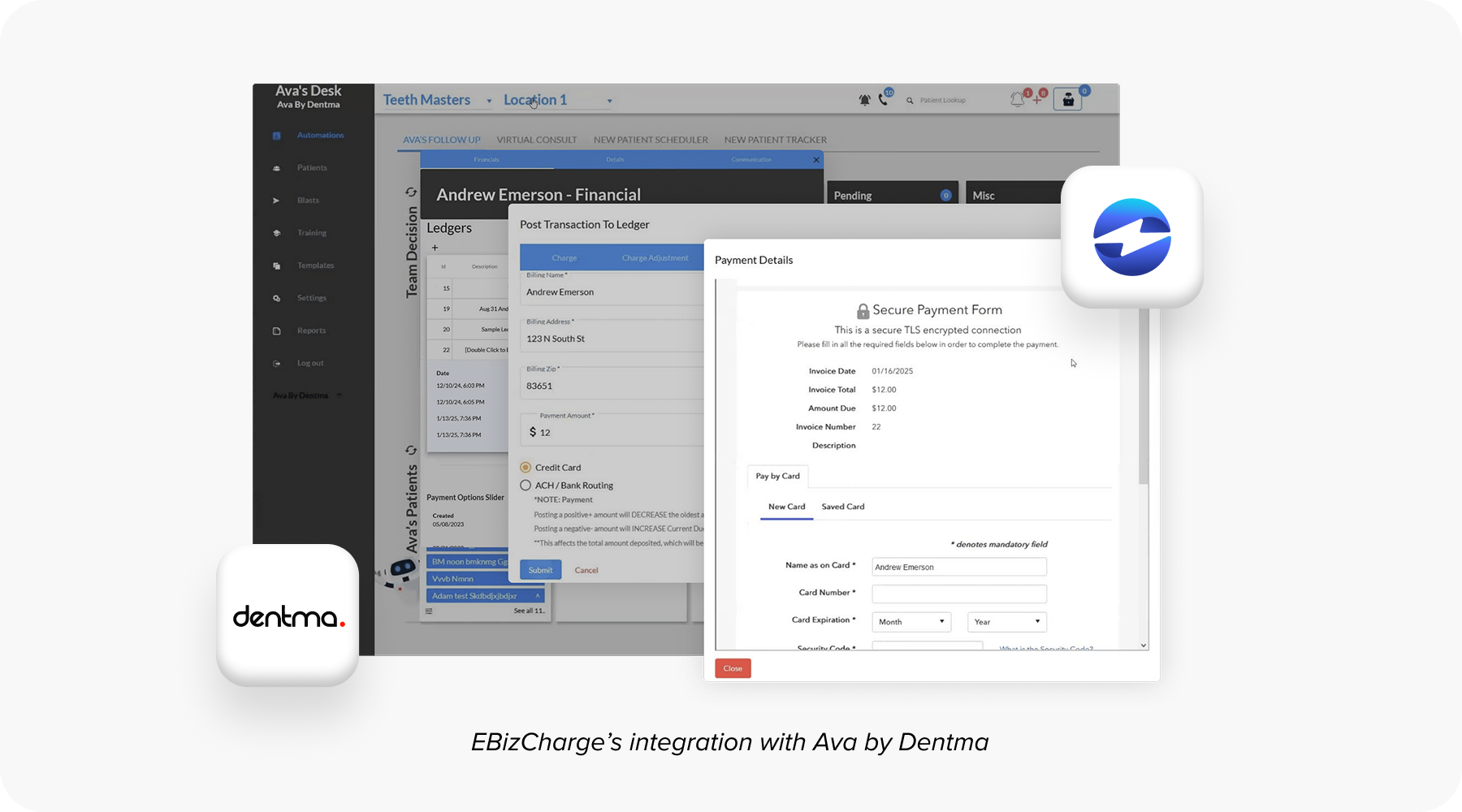
Payment solutions like EBizCharge are built with dental practices in mind. From high-ticket underwriting and recurring billing to direct integrations with the practice management software your team already uses, EBizCharge offers dental merchant services that go well beyond what a general-purpose processor provides.
If you’re evaluating your options, start with the questions above and see how EBizCharge measures up.