

Blog > EBizCharge vs. Versapay: AR Automation Comparison for ERP Users
EBizCharge vs. Versapay: AR Automation Comparison for ERP Users

If you’re reading this, you’re probably mid-evaluation on Versapay. You’ve sat through the demo, the customer portal looked good, and now you’re trying to figure out what you might be missing before you commit. This piece is meant for that moment. It’s an honest comparison of two platforms that solve the same problem in fundamentally different ways, written for finance and IT decision makers who need to get this call right.
The biggest decision in any accounts receivable automation evaluation isn’t feature parity. It’s where the software lives. Versapay lives next to your ERP and syncs into it. EBizCharge lives inside your ERP as a native module. That single architectural choice drives almost everything else: implementation timeline, total cost, support accountability, and how much your AR team has to toggle between systems on a normal Tuesday.
What Versapay Does and Who It’s Built For
Versapay is an accounts receivable automation platform built around a customer-facing collaborative portal. The product handles digital invoicing, a self-serve payment portal, AI-driven cash application, automated dunning, dispute resolution through in-app messaging, and reporting.
The platform targets midmarket finance teams, with its deepest integration in Sage Intacct. They support NetSuite, Microsoft Dynamics, Acumatica, and Oracle as well, though the depth of those integrations varies. Versapay also recently rolled out its own embedded payment processing solution, so the older critique that customers had to manage two vendors is partially resolved.
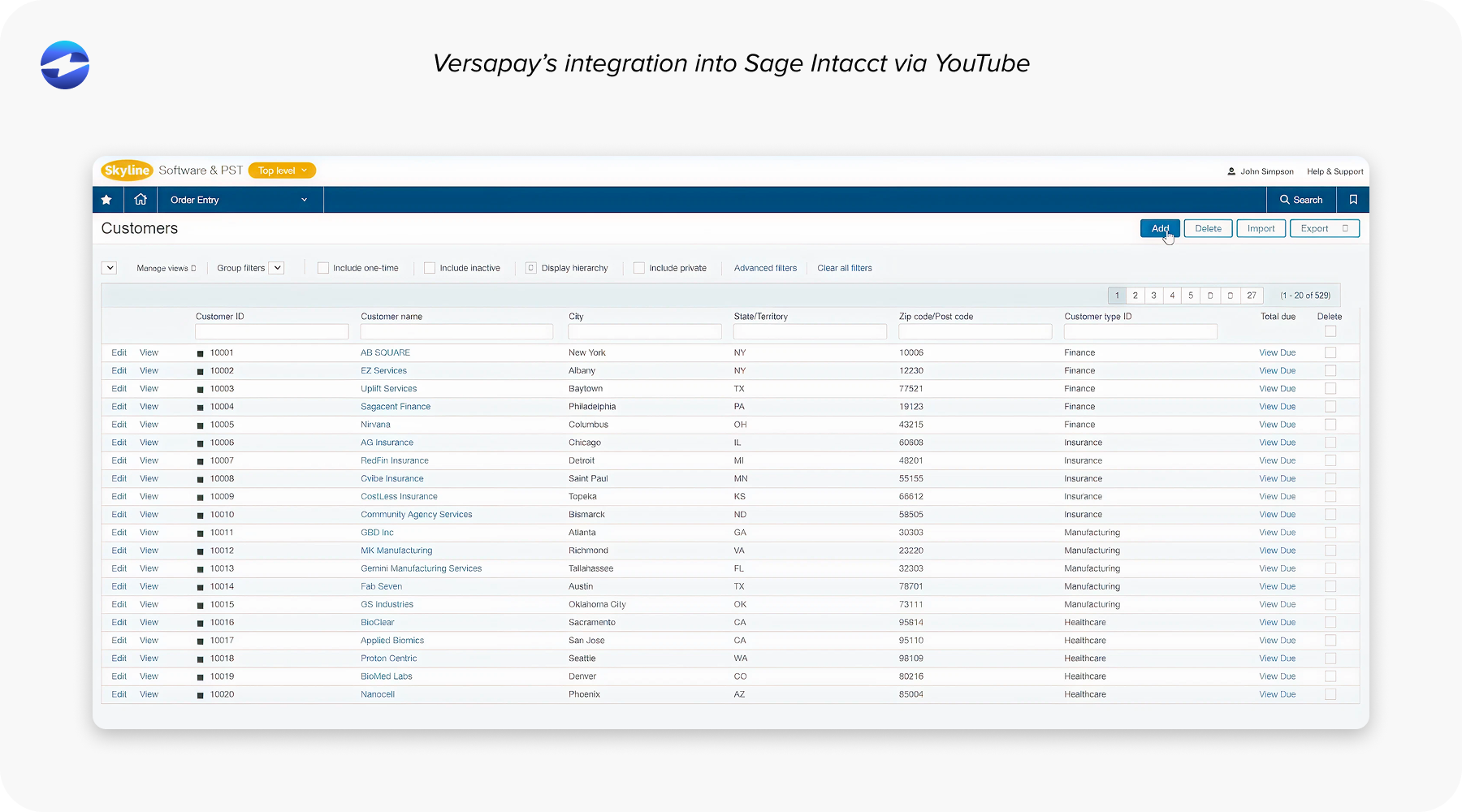
If your team has a high dispute volume and customers who log into a portal, Versapay can be a good fit.
The standalone portal problem
Here’s where the architecture matters. With Versapay, invoices are generated in your ERP and pushed out to Versapay. Payments land in Versapay first, then sync back to the ERP. Most of the time, sync works. The challenges show up on the edges.
AR clerks end up toggling between the ERP and the Versapay portal to research a single payment. Customer record updates have to happen in both systems, or one goes stale. Cash application matches in Versapay and posts to the ERP, which means your ERP isn’t the source of truth in real time. When something goes sideways with a sync, support involves both vendors and sometimes the middleware layer between them.
The portal model also depends on customer adoption. Versapay reports an 81% portal adoption rate in their best deployments, well above the 20% industry average. That number is real, but it’s also a best-case outcome. Customers who pay primarily by check or who already run AP automation tools on their side often skip the portal entirely.
By contrast, native AR automation software is rendered inside the ERP itself. Your AR team works in NetSuite, Sage Intacct, Acumatica, Dynamics, or Epicor and never leaves it. Payments post in real time to the same record where the invoice was created. There’s no sync, no second system to keep current, no portal-adoption assumption baked into the ROI math.
Versapay vs. EBizCharge: Side-By-Side
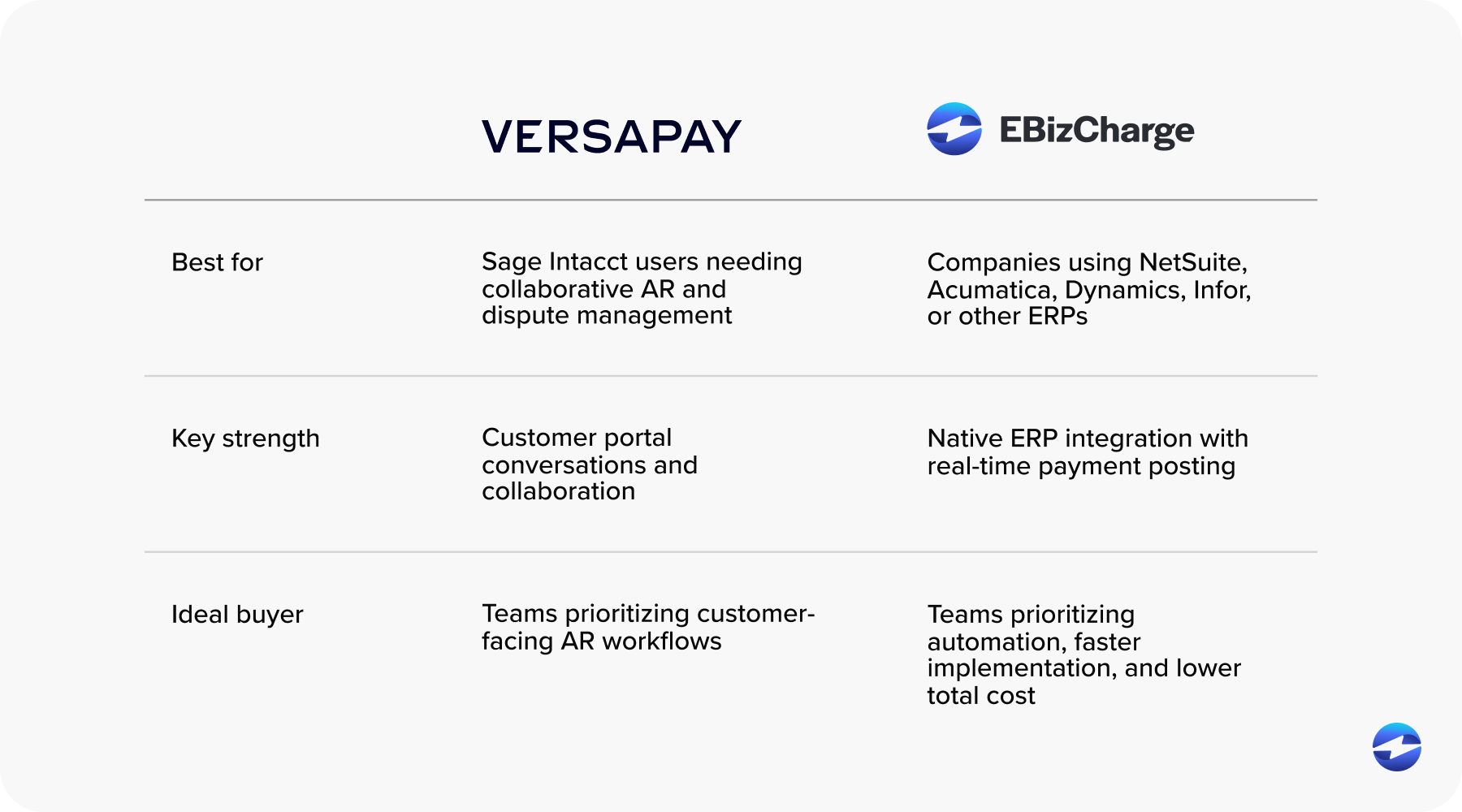
Where Versapay shines: collaboration tools, dispute resolution, customer self-service depth, and cross-entity portal visibility are all stronger. Where EBizCharge shines: integration depth across more ERPs, real-time posting without a sync layer, and single-vendor accountability across the AR automation and payment processor stack.
Pricing Model Comparison
Versapay uses a subscription model, tiered by features and user count, with add-ons for additional modules and separate fees for payment processing unless you adopt their PayFac. Public reviews on Gartner consistently flag the platform as expensive for smaller teams and note a steep learning curve.
EBizCharge pricing takes a different approach. The payment processing economics fund the AR automation layer, so the integration is included rather than billed separately. Level 3 processing and surcharging are built in, and for card-heavy operations, those features alone often offset the platform cost.
The honest framing for any CFO running this comparison: Versapay’s pricing is competitive on the platform line, but the total cost of ownership picture changes once you load in integration build cost, separate payment processing fees, and ongoing IT maintenance. For Sage Intacct shops, where Versapay’s integration is deepest, the gap narrows. For most other ERPs, the gap widens.
Implementation and Support
Versapay’s Sage Intacct deployments typically go live in 60 to 90 days. Other ERPs run longer, sometimes requiring middleware or custom configuration. Native EBizCharge deployments are measured in weeks, since the integration is pre-built and most of the work is configuration rather than engineering.
Support is the other quiet differentiator. Versapay tiers their support, with faster response times typically priced as upgrades. EBizCharge includes 24/7 U.S.-based support at no extra cost, and the same team owns both the AR automation software and the payment processing solution. When a sync breaks at month-end close, that single point of accountability matters more than most evaluators expect going in.
Who Should Choose Versapay?
Versapay is the better choice when your business runs on Sage Intacct, your AR team handles a high volume of customer disputes that benefit from threaded in-portal conversations, and your customer base is sophisticated enough to actually adopt the portal. If collaborative AR is a genuine business requirement rather than a nice-to-have, Versapay deserves a look.
Who Should Choose EBizCharge?
EBizCharge is the strongest Versapay alternative when you’re running NetSuite, Acumatica, Dynamics, Epicor, SAP, Infor, or any of the other 100-plus ERPs where Versapay’s integration depth varies. It’s also the right call when card volume is high enough that Level 3 and surcharging offset the platform cost, when IT bandwidth for sync maintenance is limited, when implementation timeline matters, and when the CFO is evaluating total cost of ownership rather than platform fee alone.
For teams that need automated cash application software posting to the ERP in real time, the native architecture is structurally faster than any portal-and-sync model. That’s not a feature comparison. It’s an architecture comparison.
Customer Examples
Both platforms produce real results. Versapay publicly references Gemaire Distributors and a Mid-Atlantic construction firm that reduced days sales outstanding (DSO) by 30%, from 60 days down to 40 days, on Sage Intacct. EBizCharge customers running native ERP integrations can reduce DSO from 45+ days to under 10 in collections-heavy deployments, saving roughly 12 hours per week on cash application work.
Both platforms accelerate cash flow when implemented well. The architectural difference shows up in how those reductions are achieved and how long the implementation takes to get there.
The Bottom Line
If you came in looking for a Versapay alternative, the decision usually comes down to one question. Do you want a standalone portal that syncs to your ERP, or do you want to automate accounts receivable from inside the ERP itself?
For Sage Intacct shops with heavy dispute workflows, Versapay is a strong fit. For everyone else evaluating Versapay competitors, the Versapay vs. EBizCharge comparison usually lands the same way: native integration produces a faster implementation, a lower total cost, and a single vendor on the hook when something needs fixing. The architectural decision to automate accounts receivable inside the ERP rather than alongside it is what drives every other ROI line over the next three years. The next step is seeing the native integration inside your actual ERP, not in a generic demo. That’s where the architecture argument either holds up, or it doesn’t.