

Accepting credit cards is one of the most important decisions a small business can make. If you only accept cash, you may be missing out on sales.
Obtaining simple and affordable credit card processing can be a challenge. Most merchants are so happy to be receiving payments that they overlook the costs of manually reconciling their invoices, entering transactions into multiple platforms, and updating their accounting software.
Manual accounting tasks, such as keeping track of paper ledgers and invoices to record financial transactions, are far from ideal. They tend to drain valuable time and resources and leave businesses more susceptible to errors. Plus, they carry security vulnerabilities that could cost a business as much as $500,000 in fines each month.
The best way to create a seamless user experience is to take advantage of integrated payments.
What are integrated payments?
An integrated payment solution automates the manual accounting process by embedding payment processing directly into your existing software, so payments and accounting work together without any manual effort in between.
An integrated payment solution embeds payment processing capabilities, allowing businesses to accept credit cards directly within their existing ERP or accounting software, CRM system, or online shopping cart. The integration automatically posts payments to invoices, so there’s no need to go back into your program to reconcile your invoices or balance your general ledger at the end of the day.
By using integrated systems, businesses can automate tasks like payment authorization, settlement, and reconciliation, ultimately reducing manual effort and the likelihood of errors. Eliminating the need for separate payment terminals or gateways simplifies the payment process and enhances customer satisfaction by offering a frictionless payment experience.
How do integrated payments work?
Here’s how a credit card transaction works without an integrated payment system:
- Receive a customer’s order over the phone or online.
- Enter their credit card number into your terminal.
- Save the transaction receipt, print out an invoice, and staple the two together. (Repeat this process for every invoice.)
- At the end of the day, match paper invoices to electronic invoices and apply payments to the proper invoices.
- Manually adjust your accounts receivable and general ledger to reflect payments.
Now here’s the same process using an integrated credit card processing solution:
- Receive a customer’s order over the phone, online, in person, or over a mobile device.
- Enter their credit card number directly into your accounting software.
- Use the integration to process the payment.
That’s it! The integration marks invoices as paid and automatically posts payments to your accounts receivable and general ledger.
Benefits of integrated payments for your business
Integrated payments can help businesses operate more efficiently and include a variety of benefits that can promote long-term growth and success.
Using integrated credit card processing in your business can help you:
1. Save time
Managing finances can be overwhelming, and this is especially true when it comes to processing payments. With manual accounting, businesses can spend hours manually entering credit card information into accounting software. This is one of the clearest benefits of an integrated payment system: your team stops spending hours on manual entry and starts spending that time on work that actually moves the business forward.
With integrated payments, you’ll no longer have to enter credit card information into accounting software each time you process a payment. Instead of having to go back and manually input every transaction detail, batch information is automatically entered into your ERP system or accounting software without any additional human interaction.
An integrated payment system streamlines your books and frees up time so you can better serve your customers. With this extra time, you’ll be able to learn new skills and focus on maximizing profits.
2. Increase cash flow
Cash flow measures how quickly you move money in and out of your business. While this may seem like a simple concept, roughly 82% of small businesses fail because of poor cash flow.
Getting paid on time is not always as easy as it seems. Manual accounting takes time and can delay your business from receiving payments on invoices for several days.
Payment integration increases your cash flow by creating an enhanced payment system that allows money to flow into your company in a simplified and effortless manner.
To help increase cash flow, use an integrated payment system that will speed up your cash flow and put more money in your bank.
With integrated credit card processing, payments are automatically posted to your accounts receivable and general ledger. Integrated card payments allow you to get paid as soon as possible, making it easier to manage finances and increase cash flow.
3. Reduce human errors
Manual accounting is tedious and time-consuming. It requires you to keep track of paper ledgers and invoices by hand, and data entry mistakes are unavoidable. Once discovered, these mistakes need to be fixed, which wastes valuable time and money. Plus, if paper records are lost or stolen, they can be impossible to replace.
Businesses can also run into errors when manually keying payment data into their ERP or accounting software. Data can be entered incorrectly, customers can be charged the wrong amount, or the wrong customer can be charged for a transaction.
Integrated payments help relieve the stress of manual accounting and make it easier for businesses to manage finances. With an integrated payment system, payments are entered directly into accounting software and applied to the general ledger or credited to an invoice. This simple process eliminates human errors and double data entry and helps businesses function as efficiently as possible.
4. Strengthen security
Manual accounting has been the default method for decades but it leaves plenty of room for security vulnerabilities. With integrated payment processing, businesses can process payments using a cloud-based payment gateway. This gives businesses the opportunity to take advantage of cloud-based accounting, which provides a more secure way of managing finances.
Cloud-based accounting software allows businesses to access data from anywhere using the internet. Since cloud accounting software runs on off-site servers, businesses don’t have to worry about system administration costs and server failures. Many cloud-based accounting programs are also PCI compliant, which helps protect credit card information in the event of a data breach.
According to Firm of the Future, most cloud-based accounting software is run from data centers, which offer multiple levels of security to protect both the software and your data. The typical data center has significantly better security than most small businesses.
Cloud accounting also protects businesses from the potential loss of a natural disaster. If a fire, flood, mudslide, or other disaster-related damages harm your office, the accounting system would still be intact and accessible from any internet-connected device. With cloud accounting, businesses can keep moving even when disaster strikes.
Integrated payment solutions vs. standalone payment processing
Standalone payment processing means your payment terminal and your accounting software operate independently. You run the card through your processor, then manually enter the transaction into your books. It works, but every step between the two systems is an opportunity for error and a drain on your team’s time.
Integrated payment solutions close that gap entirely. The payment gateway sits inside your ERP or accounting software, so the transaction and the bookkeeping happen simultaneously. There’s no batch reconciliation at the end of the day, no double data entry, and no risk of a transaction getting lost between systems.
For growing B2B businesses managing a high volume of invoices, the difference between the two approaches shows up directly in how fast you get paid and how clean your books stay.
How can I get started with integrated payments?
Whether you’re looking to improve your current payment processing system or interested in using integrated payments for the first time, there are a few important factors to consider.
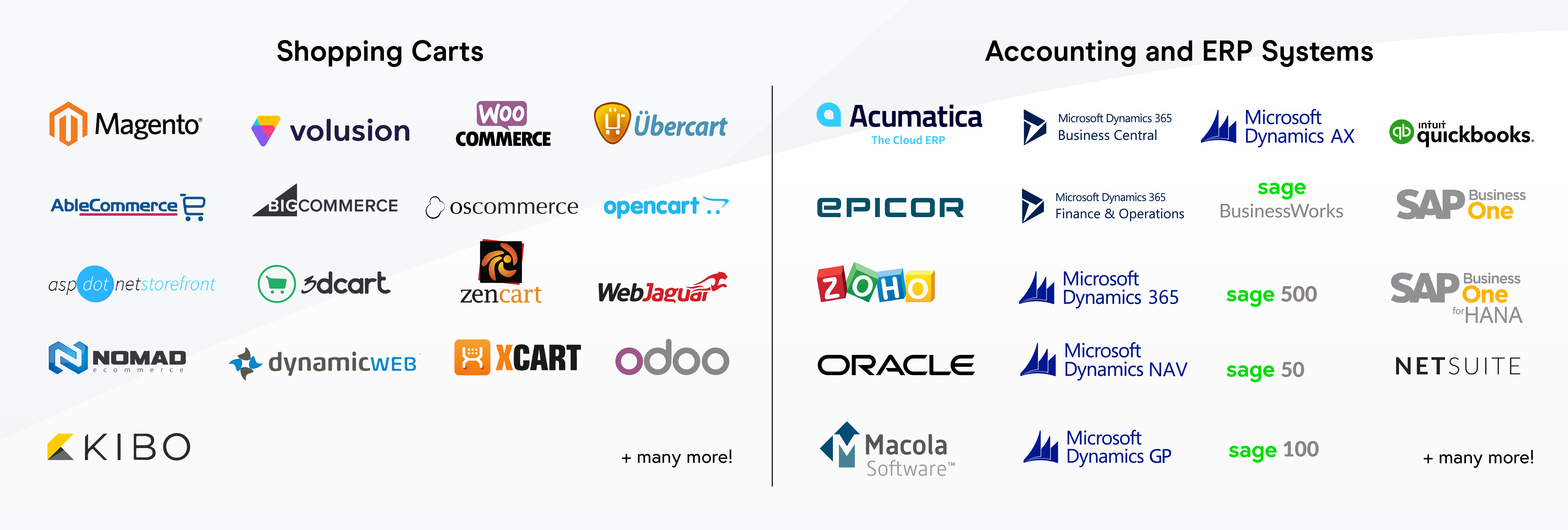
When choosing an integrated payment system, make sure to look for:
- Integration compatibility with your ERP or accounting software, CRM system, or online shopping cart
- A PCI-compliant payment gateway
- Flat rate pricing or interchange plus pricing options
- Encryption and tokenization technology for maximum data security
- Free, 24/7, in-house customer support
- Next-day funding options
- No early termination fees
Many of the most popular ERP and accounting platforms already have integrated payment options available. A QuickBooks payment gateway lets small businesses process credit cards directly within their accounting software and automatically post payments to the correct invoices. For growing companies on Acumatica, Acumatica credit card processing embeds payments into your ERP workflows so transactions are reconciled without manual intervention. And for larger organizations, NetSuite payment processing brings that same seamless experience to one of the most widely used enterprise ERPs. All three options eliminate the manual accounting steps outlined above and help your team get paid faster with fewer errors.
If your business accepts credit cards, integrated payments will eliminate the hassle of manual accounting and provide a seamless user experience. Make sure to choose an integrated payment provider that meets the criteria above and you’ll be on your way to automating payments and streamlining your accounting process.
Frequently Asked Questions
What is an integrated payment system?
An integrated payment system connects your payment processing directly to your accounting software, ERP, or CRM. When a payment is processed, it automatically posts to the corresponding invoice and updates your general ledger without any manual entry. The result is faster reconciliation, fewer errors, and a cleaner record of every transaction.
What is the difference between integrated payments and a payment gateway?
A payment gateway is the technology that authorizes and processes card transactions. Integrated payments go a step further by connecting that gateway to your existing business software. A standalone gateway processes the payment. An integrated payment solution processes the payment and automatically records it in your accounting system at the same time.
What integrated payment solutions work with ERP software?
Most major ERP platforms have integrated payment options available. QuickBooks, NetSuite, Acumatica, Sage, Microsoft Dynamics, and Epicor all support native payment integrations that allow businesses to process credit cards and ACH payments directly within the ERP without switching platforms.