
Blog > Salesforce Revenue Cloud: Complete Guide to Revenue Management
Salesforce Revenue Cloud: Complete Guide to Revenue Management
Revenue used to be fairly straightforward. You sold a product, sent an invoice, and waited to get paid. For many growing organizations today, that model no longer fits reality.
Pricing has become more dynamic, products are bundled together, and services are sold alongside subscriptions. Customers expect flexible terms, usage-based pricing, and frequent changes without disruption. Billing cycles vary, sometimes within the same customer relationship. Finance teams need clearer visibility, and sales teams need faster, more accurate quoting that doesn’t create downstream cleanup work.
This is where Salesforce Revenue Cloud enters the conversation. It’s designed to help organizations manage revenue from the first quote all the way through billing, payment, and reporting, using one connected system instead of disconnected tools.
If you are part of a sales, finance, or operations team trying to untangle revenue complexity, you are in the right place. This guide answers the question: What is Salesforce Revenue Cloud? It’ll also explore how it works and how it supports modern revenue management without turning everyday work into a maze of spreadsheets, approvals, and manual fixes.
What Is Salesforce Revenue Cloud?
At a high level, Salesforce Revenue Cloud is a suite of tools that brings pricing, quoting, billing, and revenue tracking into one connected platform built on Salesforce.
So, what is Salesforce Revenue Cloud? In simple terms, it helps businesses manage the full revenue lifecycle inside Salesforce, from the moment a quote is created to the moment revenue is recognized and payments are collected.
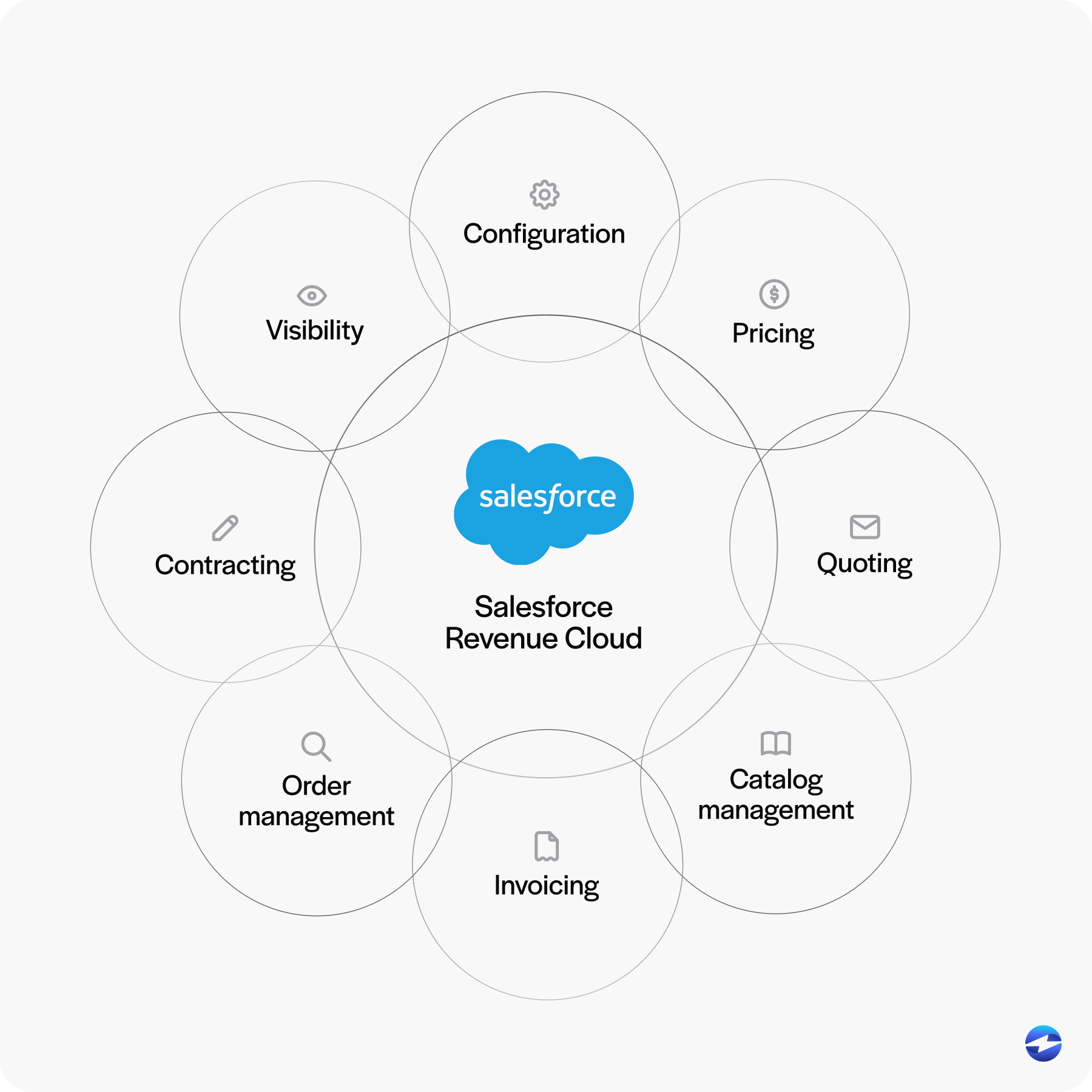
Rather than treating quoting, contracts, billing, and payments as separate processes owned by different systems, Revenue Cloud Salesforce connects them. Sales teams can create accurate quotes, finance teams can manage billing and revenue recognition with fewer adjustments, and leadership gains clearer, more reliable visibility into revenue performance.
Organizations that adopt Salesforce Revenue Management are often dealing with subscriptions, usage-based pricing, complex contracts, renewals, or frequent changes to pricing models. These are the scenarios where disconnected systems tend to break down.
Core Components of Salesforce Revenue Cloud
Salesforce Revenue Cloud is not a single product. It’s a collection of tightly connected components that work together to support end-to-end revenue workflows.
Salesforce CPQ handles product configuration, pricing, and quoting. It allows sales teams to build accurate quotes quickly while enforcing pricing rules, discounts, and approvals. This reduces errors at the front end that often create billing issues later.
Salesforce Billing manages invoicing, subscriptions, renewals, and recurring charges. It ensures billing schedules align with contract terms and pricing changes without requiring manual intervention.
Revenue recognition tools support compliance with accounting standards by spreading revenue over the appropriate time periods. This is especially important for subscriptions, long-term contracts, and usage-based billing.
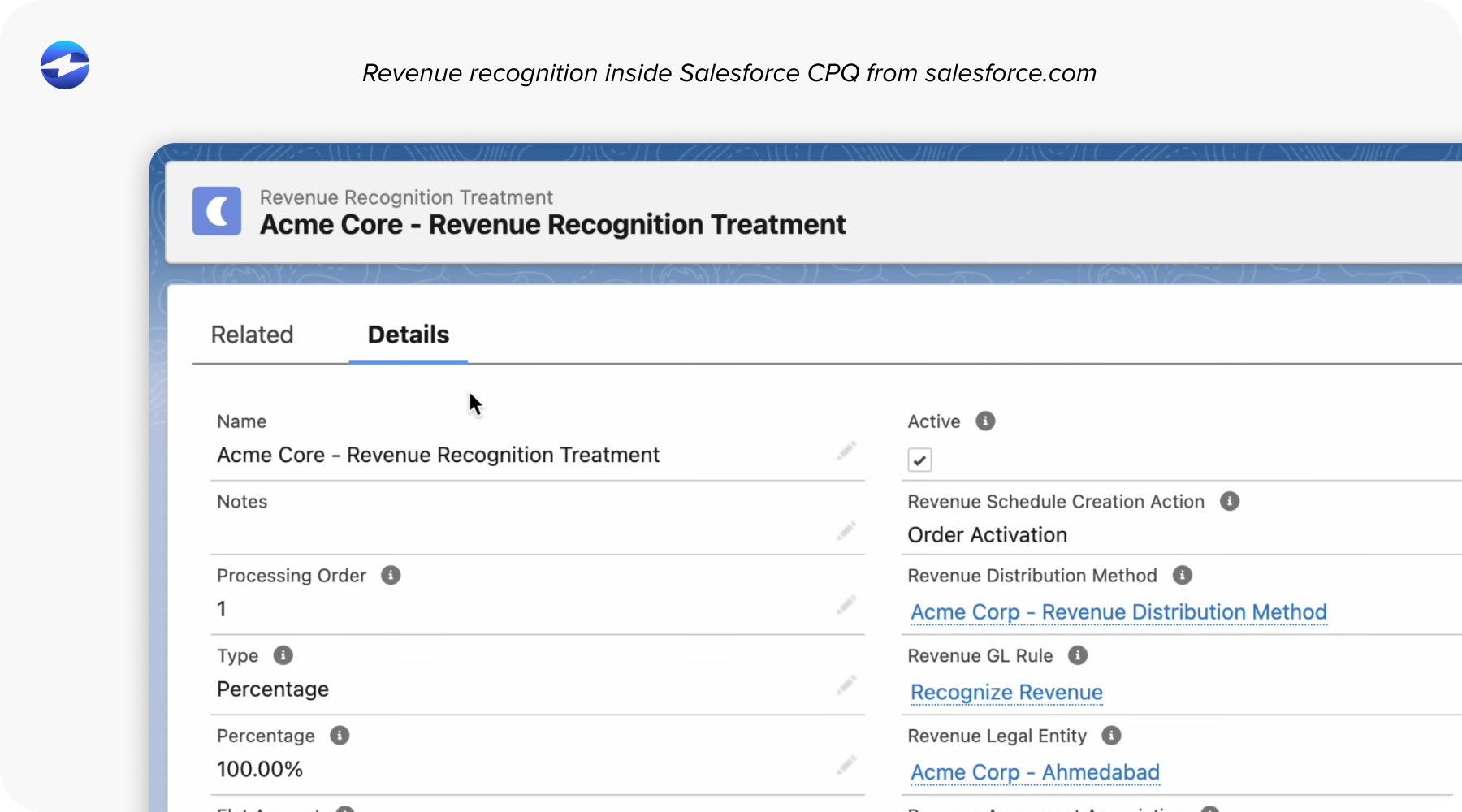
Together, these components form the backbone of Salesforce Revenue Management, allowing teams to manage revenue in one system rather than stitching together disconnected tools.
How Salesforce Revenue Cloud Supports the Quote-to-Cash Lifecycle
The quote-to-cash process touches nearly every part of the business.
Salesforce Revenue Cloud supports this lifecycle from start to finish: Products are configured correctly, prices are calculated automatically, quotes move through approval, contracts are generated from approved terms, and billing follows without rework.
For subscription-based businesses, Salesforce Revenue Cloud supports renewals, upgrades, downgrades, proration, and usage-based charges. Changes flow through the system without requiring finance teams to manually rebuild invoices or correct revenue schedules.
This alignment reduces friction between sales, finance, and operations. Everyone works from the same source of truth, which is critical as revenue models become more complex.
Revenue Management Features That Matter Most
Not every feature carries the same weight; some have a much bigger impact on daily work than others.
Pricing rules and discount controls help protect margins without slowing sales teams down, and approval workflows add structure, so pricing decisions stay consistent and defensible.
Contract management tools make it easier to handle amendments, renewals, and changes over time, without losing track of prior terms, which is critical for long-term customer relationships.
Billing automation reduces manual effort and errors, while clear payment visibility helps teams see what’s been invoiced, what’s been paid, and what still needs attention.
Reporting and analytics give leadership a clearer view into trends, forecasts, churn risk, and overall revenue performance.
These are the capabilities that lead many organizations to Revenue Cloud Salesforce, as basic billing tools can no longer keep pace with how the business operates.
Revenue Cloud and Salesforce Integrations
Integration is critical to revenue accuracy. Salesforce Revenue Cloud integrates tightly with Salesforce CRM, keeping customer data, contracts, and revenue information connected. This prevents gaps between sales activity and financial reporting.
It also connects with Salesforce ERP systems, accounting platforms, and external tools that support order fulfillment and financial operations.
A strong Salesforce integration strategy prevents duplicate entry and reduces reconciliation work. It allows Salesforce software to serve as the central hub rather than just one more system teams have to manage.
Payments and Billing in Salesforce Revenue Cloud
Billing and payments are closely connected, but they’re not always managed by the same set of tools.
Salesforce Billing handles invoicing, subscriptions, and recurring charges, while payment collection can be facilitated through native Salesforce options or through a third-party payment processing solution that specializes in handling transactions.
A dedicated payment processor can manage card payments, ACH, and other methods securely, then sync payment status back into Salesforce. This keeps payment activity visible to teams without storing sensitive payment data inside core CRM records.
This setup gives businesses flexibility. They can choose a payment solution that fits their transaction volume, geographic needs, and customer preferences, all without sacrificing reporting accuracy or operational clarity.
Security, Compliance, and Revenue Controls
As revenue models become more complex, compliance requirements grow as well. Salesforce Revenue Cloud supports access controls, audit trails, and role-based permissions that help organizations meet internal and external requirements.
Revenue recognition tools support accounting standards and audit readiness. Payment data is often handled outside Salesforce through secure integrations to reduce risk.
A PCI-compliant payment processing solution helps protect sensitive information while keeping workflows intact.
Security isn’t just about protection. It’s about trust between the businesses, customers, and regulators.
Who Should Consider Salesforce Revenue Cloud
Salesforce Revenue Cloud isn’t something every business needs right away.
It tends to be most valuable once revenue becomes more complicated, like when you’re managing subscriptions, complex pricing structures, frequent contract changes, or a high volume of transactions that are hard to track manually.
SaaS companies, service organizations, manufacturers, and other subscription-based businesses often see the biggest benefit because their billing models are rarely simple or static.
If your teams rely heavily on spreadsheets to manage billing adjustments, or if reconciling revenue across systems feels like a constant struggle, Salesforce Revenue Management may be the right next step toward a more scalable and connected process.
Supporting Payment Collection with EBizCharge
Revenue management is no longer just a back-office responsibility. It directly shapes customer experience, cash flow, and long-term growth, especially as pricing models and billing structures become more complex.
Salesforce Revenue Cloud provides the framework for managing quoting, billing, and revenue recognition in a more connected way. It helps teams keep contracts, invoices, and revenue schedules aligned inside Salesforce, rather than spread across disconnected systems.
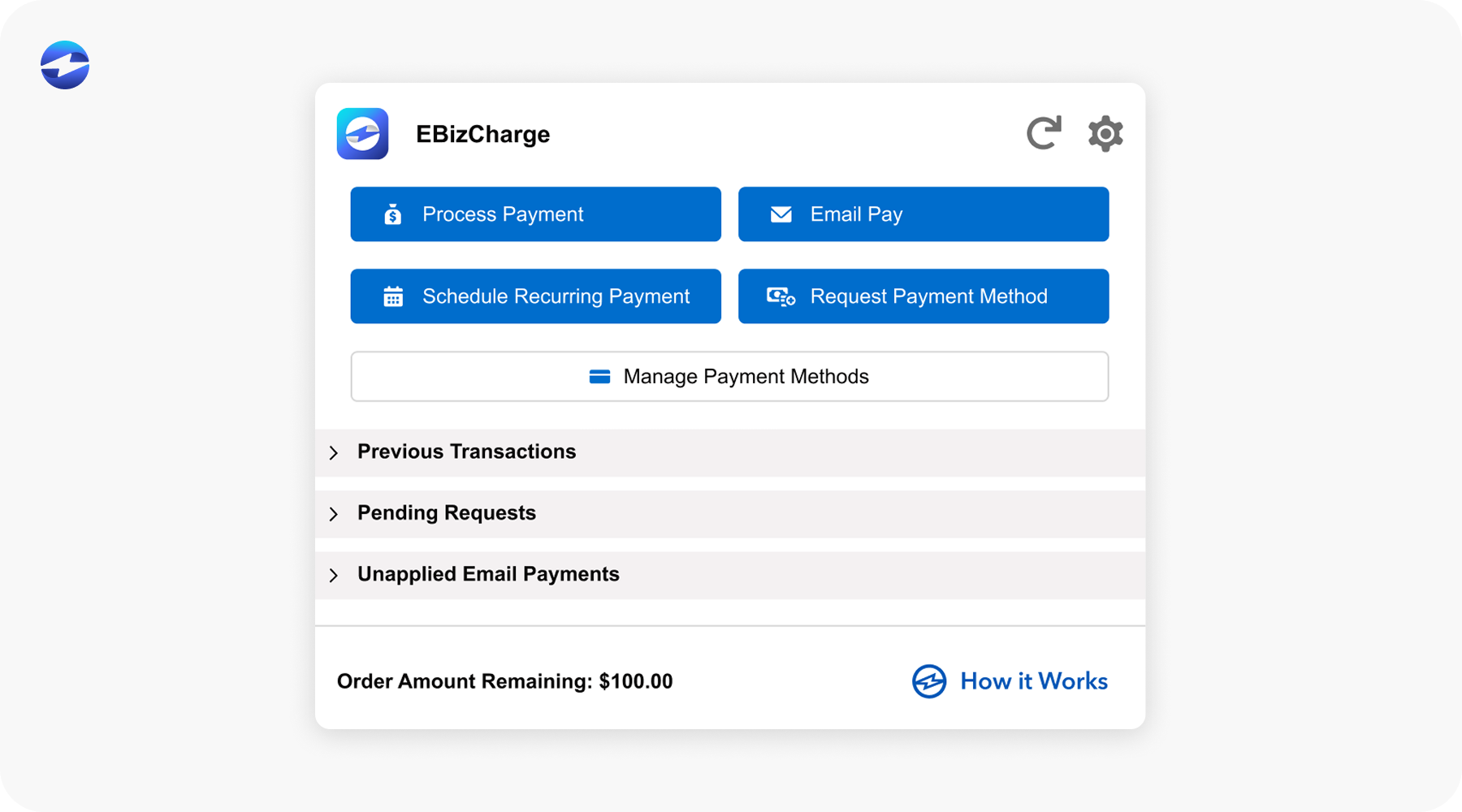
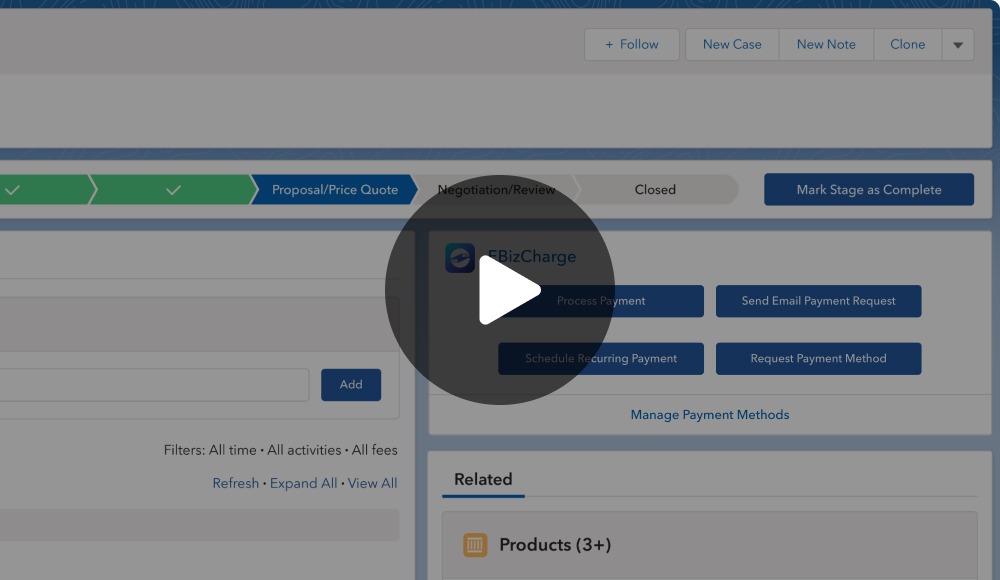
This is where a solution like EBizCharge can complement Revenue Cloud. While Revenue Cloud focuses on managing revenue logic and billing workflows, EBizCharge can support the actual collection of payments through a secure payment processing solution that connects back to Salesforce. Payments are processed, posted, and reflected in Salesforce records without adding manual steps for finance teams.
With the right Salesforce integration strategy, Revenue Cloud and EBizCharge work together to close the loop between billing and payment collection. Used this way, Revenue Cloud Salesforce becomes a strong foundation for predictable, scalable revenue management, supported by a payment solution that helps revenue actually move from invoice to cash.
- What Is Salesforce Revenue Cloud?
- Core Components of Salesforce Revenue Cloud
- How Salesforce Revenue Cloud Supports the Quote-to-Cash Lifecycle
- Revenue Management Features That Matter Most
- Revenue Cloud and Salesforce Integrations
- Payments and Billing in Salesforce Revenue Cloud
- Security, Compliance, and Revenue Controls
- Who Should Consider Salesforce Revenue Cloud
- Supporting Payment Collection with EBizCharge